
A worm, and a firmament of stars

David Torrance is a journalist who irritates me more than he ought. Not that that's his problem; it's mine entirely, I ought not to allow myself to become so annoyed. But he is, for me, the exemplar of Scotland's tall poppy syndrome: see anyone talented, competent, able beyond what Torrance believes to be their deserts, and he will attack. His attacks are subtle: he uses innuendo, faint praise, dismissive reference, imputation of ill motives; never, as far as I'm aware, outright verifiable falsehood. I suspect he checks his facts carefully — indeed he must do so, since if he did not he would surely find himself before the courts on a regular basis. He's also — viciously — tribal. His detestation of the Scottish National Party bleeds through every piece he writes; his praise for the Labour right is lavish and unstinting. At least it could never be said of him that he pretends to balance.
Instead, he pretends to erudition. In today's scrawling in the Herald, he casts himself somewhat incongruously as a bible-thumper, making heavy reference to Deuteronomy; and, in case his audience is so unlairit as not fully to appreciate his facile cleverness, when he quotes from the Gospel according to Luke, he very helpfully cites chapter and verse.
Credit where credit's due: Russell Brown MP

So this evening I fired of yet another of my intemperate emails to my MP. I say 'my' MP. He's the MP for my home. But since I'm still legally homeless, I'm actually currently registered to vote in Glasgow. I've literally no idea who the MP where my vote is registered in Glasgow actually is, although I think my MSP may just have become First Minister. But I think of Russell Brown as my MP, because he's the MP for where I actually live.
I have very mixed feelings about Russell Brown. As a human being I think he's a very decent one. I like him. I've seen him attending events for mad people — people with mental illness — where there was no possible publicity benefit from doing so. And, furthermore, treating us with dignity and respect, as equal citizens. Which of course we are, but it still impressed me positively. I've seen him turn up in person at anti-Nazi rallies. He's also, I'm told, a 'good constituency MP' — which is to say the social worker of last resort for those defeated by the bureaucracy. Which is a good and honourable role, and someone has to do it.
Bigbale: scaling up the Winter Palace to family size
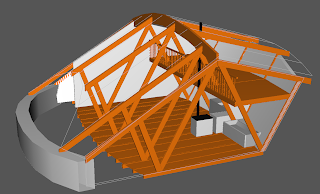
The Winter Palace was built for less than £5,500, because that was all I had. But that figure included the stove and its chimney, the plumbing, and quarter of a mile of water pipe in a trench over a metre deep. The front glass cost another £1,400, and the roof lining cost an unbudgetted extra £200; so I always quote a figure of £7,000 for the whole building. It's a building of 30 square metres floor area, so its cost is about £233 per square metre. And those figures are inclusive of VAT, because while someone self-building a legal house can reclaim their VAT, someone building an illegal house cannot.
However, a dwelling with twice the usable volume does not need to consume twice the materials. 'Bigbale' was a design exercise to see how one would build family sized house using what I've learned from the Winter Palace.
How have the mighty fallen

This is not an anti-Labour blog. I am not anti-Labour. I don't support them, but I don't hate them. I'm about to say some very harsh things about them. I hope they're harsh but helpful; however, even if they're seen as harsh and unhelpful I'd like to point out that I have in the past said equally harsh things about the SNP. This is not partisan or tribal harshness, I'm not seeking to advance the cause of any other particular party. I'm trying to explore why the Labour Party have fallen so far from the ideals on which it was founded.
And I want to start with this absolutely shocking image. How does it shock me? Let me count the ways:
Scottish Devolution, and Socialism in One Nation
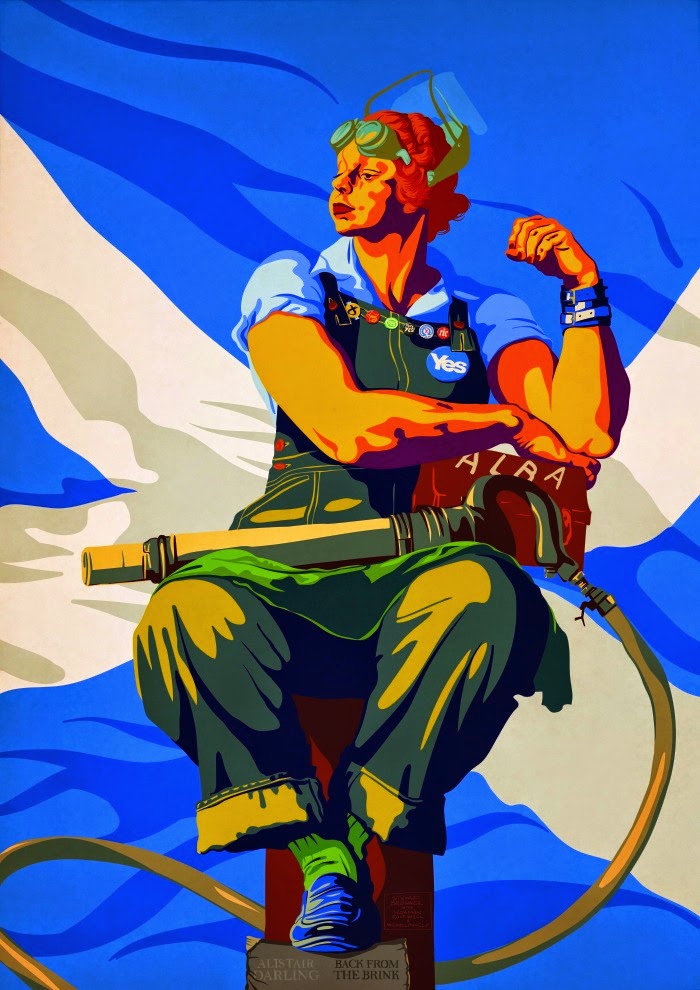
[This is a submission to the Smith Commission, written mainly by me but on behalf of Radical Independence Dumfries and Galloway. It's separate from (and deals with different issues to) my own submission, which is here. My instructions from Comrade Lucy were 'Just scrawl "full communism now" on rahbackuvvah silver rizla'. I may have written slightly more. Thanks to everyone who contributed.]
Dear Commissioners