
State of Play
I last posted here about my life and the state of the farm in May; it's time to post again. It's autumn, and I have now spent five months living in my simple tree house. And actually, that's mostly been good. I've been, over all, much more comfortable than I expected, and the cats have certainly liked it. But the tree house — my 'Summer Palace' — was always only intended to be a temporary structure. I was going to live here until I'd got planning permission to build the house I wanted. Well, I haven't got planning permission — not because it's been refused but because it's all taken much longer than expected.
The summer has been, as you'll know, both wet and cold, but for me it's been a mostly contented time. My home — not just my little shelter, but my wood and my whole croft — is exceptionally beautiful. It's also a very calm and quiet place, except for the one weekend of the year they hold a rock concert just beyond my wall. I've had a good hay harvest, and still have barley standing which I hope to harvest soon.
Storm
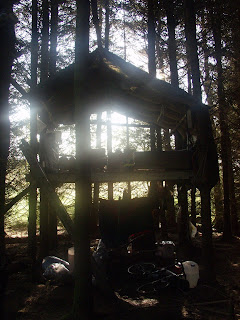
My summer residence is supported on seven spruce trees. In the time I've been here — since early May — the BBC have twice forecast hurricane force winds. The first time, I abandoned ship — but they exaggerated, it was only storm force. This time, I haven't abandoned, and it's now too late to do so. The wind on the hilltop is too high to safely evacuate the cats. I suspect, and hope, that the BBC are exaggerating again, but earlier this morning I described the wind as the second strongest I'd ever experienced. That's no longer true.
It literally is not possible for a grown man to stand upright in the gusts on our hilltop now. I know that, because I've just been there. So I'm going to have to stay put. On the plus side, my wood shows no evidence at all of windfall trees. So far as I can see, no tree of the present generation has ever blown down. And although I have thinned a little, I've been careful to preserve the green edge of the wood — I really think it's wind-firm.
Fenestration
When someone approaches my building, the first thing — and the dominant thing — they're likely to see is the fenestration. That's because pretty much everything else is buried in the hillside; the only face of the structure that's exposed is the south face, which is primarily glass. My intention has always been to use commercial patio door units, because they're mass produced they're far cheaper than any custom unit I can make myself, while having well engineered latches and reasonable insulation.
In the 'sousterrain' design, the shape of the fenestration was to some extent masked by the eyebrow lintels and flying butresses. All the swoopy curves of the exposed concrete structure relieve the industrial regularity of the windows. In my first 'singlespace' drawings, I set the window units back behind the pillars, and thus behind the ring-beam and its braces, and this too masks the shape a bit.
But in reconsidering the front joinery I've considered first that the elements of the frontage are extremely visible, and second that they're exposed to weather. While making the rest of the structure in softwood seems acceptable to me, using oak for the front pillars and lintels will both reduce maintenance and add elegance. Given that it's only five pillars and four lintels, the increased cost is not going to be high. And it you're going to do that, the relatively lightweight 200x50 mm lintels of the front ring beam as originally planned are going to look wrong (and in any case require a lot of additional joinery to make a weatherproof space). Better, I thought, to make them true lintels, with a section of 200x200 mm or possibly even more. Yes, more expensive and not required from an engineering point of view, but the fenestration can now be fitted directly into the aperture between pillars, sill and lintels, completely solving the weatherproofing problem.
Plan B
Of course Plan A is to get planning permission. Of course Plan A is to live in a proper, legitimate house, pay council tax and have my rubbish collected in bins. But that may not happen. It, actually, may not happen for three reasons. Firstly, and very probably, planning permission may simply be refused. That is actually pretty likely — I probably have less than 50% chance of getting planning permission anyway.
Secondly, planning permission may be granted but it may be granted too late. I must have something considerably more comfortable and weatherproof than the Summer Palace before winter; neither my mental nor my physical health would stand up to a winter spent literally out of doors. So if I haven't got planning permission by mid-July I have to go to plan B anyway.
Building plan for the Winter Palace
If the bothy I'm wryly referring to as the Winter Palace is to be built in one weekend — hopefully in one day — a lot of preparation has to be done first. Let's start with the basics: materials.
The winter palace comprises straw bales, timber, render, insulation and a few other things. It would be elegant if the straw bales came from barley crop and, in theory, they might. But I'm not confident that my barley will be ready to harvest in time, so it would be prudent to get bales from another source. Similarly there would be a lot to be said for using timber from my own wood; in terms of energy and the environment it would be the best solution. But I'm not at all confident we can mill enough timber in time and even if we do it will be horribly unseasoned. So, again, it may be prudent to buy the timber from the builders' merchant.