By: Simon Brooke :: 28 January 2026
Don't study theology, friends. In particular, don't study the Abrahamic religions. It will make you deeply cynical.
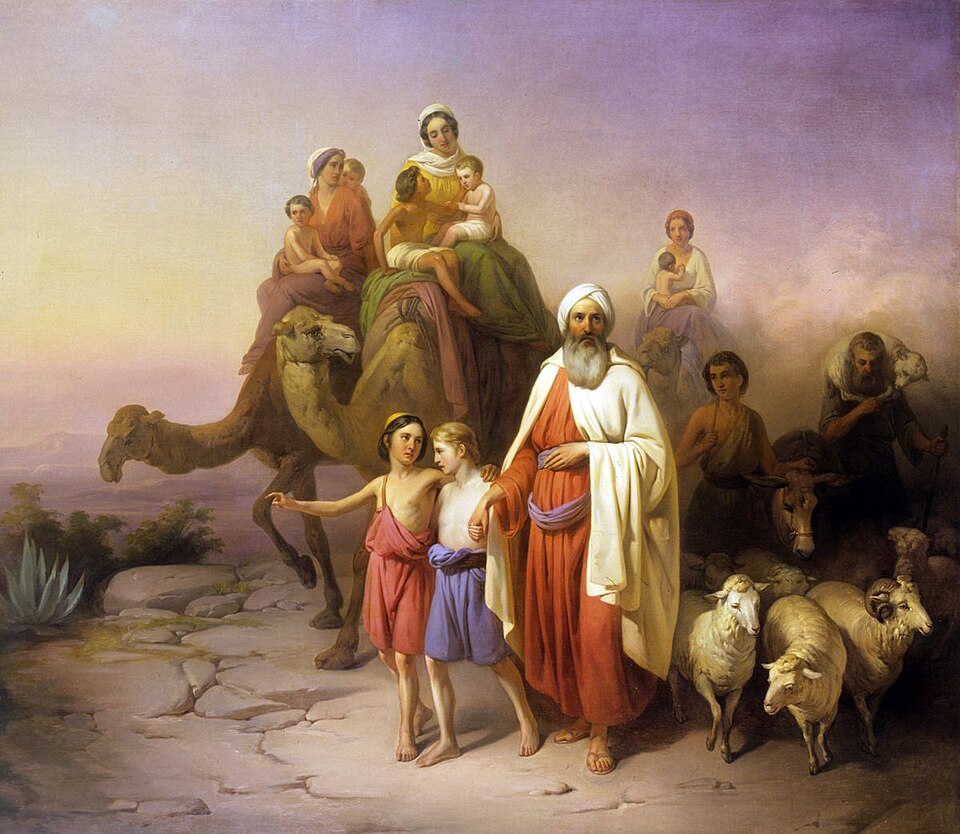
The Promised Land, say many within the Zionist tradition, was given to the Jewish people by their god. Irrespective of whether you believe in their god, is that what the record actually shows?
Firstly, where is this 'promised land?' The source says first:
And Abram passed through the land unto the place of Sichem, unto the plain of Moreh. And the Canaanite was then in the land. And the LORD appeared unto Abram, and said, Unto thy seed will I give this land: and there builded he an altar unto the LORD, who appeared unto him. — source (Bible): Genesis 12:6-7; (Torah): Bereshit 12:6-7
This seems to be the fairly level area between the present day Palestinian villages of Jalamah and Beit Qad, in the northern West Bank.
But very soon after we get this passage:
And the LORD said unto Abram, after that Lot was separated from him, Lift up now thine eyes, and look from the place where thou art northward, and southward, and eastward, and westward: For all the land which thou seest, to thee will I give it, and to thy seed for ever. — source (Bible): Genesis 13:14-15; (Torah): Bereshit 13:14-15
The place where Abram's tent was pitched in this passage was 'a mountain on the east of Beth-el,' so possibly El Munya, 590 metres tall. Even if Abraham's1 new camp was on the very summit, well, it's not an enormously high hill, and there are other hills round about. So you could see, probably, a maximum of sixty kilometres in any direction. Which is to say, from a little north of Hebron to fifteen kilometres south of the Sea of Galilee.
But even this isn't enough, so a few verses later we get a third bite at the same cherry:
In the same day the LORD made a covenant with Abram, saying, Unto thy seed have I given this land, from the river of Egypt unto the great river, the river Euphrates. — *source (Bible): Genesis 15:17-18; (Torah): Bereshit 15:18.
The 'River of Egypt' is believed by scholars to mean not the Nile, but a wadi in Gaza called Nahal Habesor. So this claim covers about three quarters of a million square kilometres: most of modern Palestine, Jordan, Syria, and Iraq (although not southern Gaza).
I'd like you to try a thought experiment for me.
Imagine your father has just died. You're sadly clearing out his house, trying to decide what to do with his things, when a man comes to the door. A stranger. Someone you've never met before. The man says, "your father and I were friends, and he said that when he died, he'd leave me his wrist watch, as a keepsake," so you give him your father's wrist watch. It's just a wrist watch.
The next day, you've rolled your father's car out of the garage, and you're cleaning it, wondering what to do with it. It's an old car, but it's been well maintained, and it's a good make. You remember journeys in it as a child. It has sentimental value, and it would be worth something if sold. The same man comes by, and he says, "your father and I were great friends, and he said that, when he died, he's leave me his car." You're a bit suspicious, but you give him the keys to the car, and he drives it away. It's a shame, you liked that car.
The third day, you're still tidying the house, and he's there at the door again. "Your father and I were such good friends," he says, "that he said that when he died he'd leave me his house..."
What I, as a sceptic, see, reading these claims, is that the God of Abraham was claimed — presumably by Abraham, since we don't have any other named witness — to have made three successive grants of land to Abraham, and that each successive grant was vastly larger than the previous one. First a place; second, all the land that could be seen from a (small) mountain; and thirdly, all the land from the borders of modern Egypt to Basra and Baghdad.
I see a process of exaggeration. If you're literally an eternal, all knowing god, you might conceivably make a grant of land to a person; I can't say that that's impossible. But to make three separate, successive grants to the same person, each much greater than the last? That strikes me to be inconstant, and inconstancy is not a quality I'd expect to find in the numinous.
These lands weren't empty lands. Even the first small portion was said to be populated by Canaanites. The third claimed area is the lands of
The Kenites, and the Kenizzites, and the Kadmonites, And the Hittites, and the Perizzites, and the Rephaims, And the Amorites, and the Canaanites, and the Girgashites, and the Jebusites. — source (Bible): Genesis 15:19-21; (Torah): Bereshit 15:19-21
Making a claim — nicely wrapped in religious language, but still a claim — to lands that others already occupy is the very essence of settler colonialism.
But clearly, if the God of Abraham did indeed grant the land to anyone, the people to whom the God of Abraham gave the land were Abraham and his descendants.
Who are his descendants?
Abraham had a son Isaac who had a son Jacob who had twelve sons. The Twelve Tribes of Israel are descended from those sons of Jacob. But Isaac wasn't Abraham's only son. First he had an illegitimate son, Ishmael, by a woman called Hagar, who was his wife Sarah's servant. Then he had Isaac, by Sarah; and he then married a younger woman called Ketura, by whom he had six more sons.
His son Isaac married Rebekah, and they had two sons, Jacob and Esau.
So, the bible doesn't record what happened to the offspring of six of the eight sons of Abraham. If they survived and had descendants, they also are 'of the seed of Abraham'. Ishmael did have descendants, who are said to have become the Arabs. Esau also had descendants, they were the Edomites. They also are — legitimately, for what that's worth — 'of the seed of Abraham'.
Of the twelve tribes, ten were 'lost' after the conquest of Israel and Judea by the Assyrians around 720 BCE. The Assyrians resettled captured populations, but they didn't normally commit genocide. So those ten 'lost' tribes presumably continued to exist somewhere in the general region, although they are not mentioned again in the Torah. The Roman-period Jewish historian Josephus believed that in his time they were still living, 'beyond the Euphrates'. So the Jews of Judea in the time of their last independent king were descended from the lines of Judah, Benjamin, Levi.
Oh, and finally Esau. Esau's line, the Edomites, settled originally in the centre of what is now the Arabian Peninsula (and is now very much desert) but were later driven westward and eventually reintegrated into the Kingdom of Judea just before its takeover by the Romans (those who had not already suffered genocide — read on for detail).
There were six other bloodlines from Abraham, ten other bloodlines from Jacob, and twelve from Ishmael, all of them 'of the seed of Abraham,' who were not in Judea and were not Jews. In other words, the Jews make up three out of twenty eight branches of the family tree to which the promise is claimed to have been made.
The Torah, of course, claims that Ishmael, as the son of a servant, was not legitimate, and that his line should not inherit. But again, is punishing the child for an act of his father something you can imagine a good god doing?
Should we be surprised that the peoples of the Bronze Age chose to create their gods in their own image? After all, in the present day, the American Right have managed to recreate Jesus of Nazareth in their own image, a far more audacious intellectual feat.
We should, I think, accept gods as intellectual constructs through which to approach the numinous; they're necessary, perhaps, because the numinous is just so god-damned hard for the human mind to approach. And I think we probably ought to understand them as, at least in the time of their creation, sincere attempts to approach the numinous.
But should we, five thousand years later, still revere this god made in the image of savage, bloodthirsty, patriarchal, xenophobic warrior nomads? And should we accept all those things that god is claimed and recorded to have said as binding on us now? Do these judgements, these gifts, these values reflect anything that we perceive when we now sit in silence and listen for the voice of god?
After all, we know — we see it in our own day — that throughout history, politicians and prelates have claimed the blessings of their gods to support their own short-term political ends. Is it possible that Abraham, in claiming that his god had given to him and to his descendants the lands already occupied at the time by other peoples, was doing just exactly what Patriarch Kirill has done in this sermon?
Another prophet, claiming to ventriloquise the same god, urged the extermination — the genocide, the holocaust — of the Amalekites.
Thus saith the Lord of hosts, I remember that which Amalek did to Israel, how he laid wait for him in the way, when he came up from Egypt.
Now go and smite Amalek, and utterly destroy all that they have, and spare them not; but slay both man and woman, infant and suckling, ox and sheep, camel and ass. — source (Bible): Samuel 15:2-3; (Nevi'im): Shmuel I 15:2-3
Who are the Amalekites? According to the Torah, they are the descendants of Amalek, a son of Elphaz, who was a son of Esau, who was the son of the legitimate Isaac; and thus Amalek was a great, great grandson of Abraham. Literally, of the seed of Abraham. So here, we have a claim that the God of Abraham has urged, or ordered, one branch of the seed of Abraham to slaughter another branch down to the last babe in arms.
Again, in this passage, god is claimed to have said to Samuel2
It repenteth me that I have set up Saul to be king — source (Bible): Samuel 15:11; (Nevi'im): Shmuel 1 15:11
This is (claimed to be) the word of god. God is saying that he3 regrets doing something which he'd done only a few years before. Do we really believe in an omniscient god that cannot foresee the consequences of their own actions?
Of course, the genocide of the Amalekites was not the only, nor even the first, genocide that the God of Abraham is recorded to have ordered.
Joshua said unto the people, Shout; for the Lord hath given you the city.
And the city shall be accursed, even it, and all that are therein, to the Lord: only Rahab the harlot shall live, she and all that are with her in the house, because she hid the messengers that we sent...
But all the silver, and gold, and vessels of brass and iron, are consecrated unto the Lord: they shall come into the treasury of the Lord. — source (Bible) Joshua 6:16-19; (Nevi'im) Yehoshua 6:16-19
One prostitute and her household — just one household, out of the whole city — is to be spared.
Do we believe in a god that orders genocides? Do we believe that this is something the numinous, the eternal spirit, might order? Or should we rather see Joshua and Samuel as just another pair of bad-faith actors, each in turn the Netanyahu of his day; Samuel, in particular, seeking to justify his later coup d'état against King Saul?
That's the deep past, of course. Who claims this promised land in the present, and does this dusty myth really support their claims to it?
The Jews
Judaism is at once a religion and an ethnicity. To say that it is a religion is to say the it has a common theology and a common set of religious practices: there are beliefs to which all (religious) Jews adhere, and practices which all (religious) Jews follow. To say that it is an ethnicity is to say that all Jews have a common ancestry, all claiming descent from Abraham. It is tradition in Judaism to practice endogamy; that is to say, for members of the group to marry only other members of the group. But Jewish tradition, perhaps wisely, considers the children of a Jewish woman to be Jewish, whether or not the father was also Jewish; so the ethnicity is at best porous. Consider the closely related Samaritans, who accept into their tradition only those whose parents were both Samaritans, and who today have much more homogeneous genetics than modern Jews.
A person can be a sincere adherent of the Jewish religion — sincerely believing its theology and devoutly adhering to its practices — without being an ethnic Jew; and a person can be able to trace their descent all the way back to the classical Kingdom of Judea without being an adherent of the Jewish religion. It's reasonable to accept people in both these subgroups as being authentic Jews.
Of course, purity of ethnicity is rare, and usually only occurs in stable, isolated populations. People interbreed; even if consensual relationships across ethnic divides are anathematised, rape happens; and few populations, historically, have systematically killed or exiled the children of rape victims. This is as true of Jewish populations as of any others.
The Ashkenazim are a Jewish population with its roots in medieval Germany. Some of its ancestry, as recorded in mitochondrial DNA, is from the classical period eastern Mediterranean, and it is reasonable to suppose that some of this is from the former subjects of the kings of Judea. However, there is evidence through Y-DNA that many of the male ancestors of the Ashkenazim were natives not of the Levant, but of Italy.
The Sephardim are a group with roots in early medieval Iberia (Spain and Portugal), which flourished under the Islamic caliphate there, and which was then largely driven out in the Christian reconquest. Their DNA shows substantial southern European admixtures.
The Krymchaks are a Jewish group which formed in Crimea in the early centuries of the current era. While some of their ancestors were almost certainly from classical period Judea, some were Crimean native converts, and there are twelfth century Jewish documents describing a large conversion of ethnic Khazars into Judaism — and hence into the Krymchak gene pool.
The Crimean Karaites are a theologically distinct Jewish tradition which also developed in Crimea at about the same time and which is also believed to have accepted converts from people of Khazar or Cuman ethnicity.
In summary, there are many vectors through which non-Jewish blood has entered the bloodstream of modern Jews. The claim that modern Jews are mostly descended from Abraham is almost certainly true, but the claim that they're all pure blooded descendants is very much not.
Who else might be?
The Palestinians
The people we now call 'the Palestinians' are simply the descendants of the people who were living in Palestine under the British Mandate. That territory included all the lands between the river [Jordan] and the [Mediterranean] sea, and thus included the lands of the historical Kingdom of Judea, the ancient homeland of the Jews.
But the people who lived in that part of Mandatory Palestine which had been the Kingdom of Judea and is now mostly the West Bank were (mostly) the descendants of the people who lived on those same lands under the Ottoman Empire, who were (mostly) the descendants of the people who lived on those same lands under the Kingdoms of Outremer, who were (mostly) the descendants of the people who lived on those same lands under the Fatimid Caliphate, who were (mostly) the descendants of the people who lived on those same lands under the Rashidun Caliphate, who were (mostly) the descendants of the people who lived on those same lands under the Byzantine Empire, who were (mostly) the descendants of the people who lived on those same lands under the Roman Empire, who were (mostly) the descendants of the people who lived on those same lands under Antigonus II Mattathias, the last independent king of Judea.
And those people were Jews. They claimed Abraham (and his legitimate son, Isaac) as blood ancestors.
Rulers came and went. Aristocracies and other elites may have done the same. But the people who lived in the villages and tended their goat herds and their olive trees, and, before 636 CE, their famous vineyards, were the same people, more or less, descending father to son and mother to daughter, living in the same villages and tending literally the same olive trees, from the fall of the Kingdom of Judea until Israeli settlers burned, bulldozed or cut those trees down. Modern DNA evidence proves that this is true.
There's a claim that Palestinians are Ishmaelites, and therefore from the illegitimate branch of the family. But that cannot be true of the majority, simply because of the continuity of occupation. Genetic studies show that they are descended from the people who lived on the same lands at the turn of the era, and those people, as I've said. were Jews.
Or else, if they were not Jews, then those people who now call themselves 'Jews' are also not Jews, because insofar as they are not descended from Iberians or Italians or Germans or peoples from Crimea, or other host peoples of their diaspora, they are descended from exactly that same population.
Judaism and Islam
But wait, you say, aren't the Palestinians Muslim?
Well, yes, mostly they are.
But wait.
I said at the top of this essay that Jewishness is both an ethnicity and a religion. I've shown, above, that many — not all — of the Palestinians, especially in the West Bank, are ethnically every bit as Jewish as the most Jewish of the new Israeli immigrants.
But are they religiously just as Jewish?
What does is mean to be a Muslim?
Islam is built on Jewish tradition. Islam and Judaism share the same god; they share forty six of the same prophets, out of the forty eight male prophets recognised by Rabbinical Judaism (Judaism also recognises seven female prophets). But both traditions acknowledge the possibility of other prophets not listed in their scriptures.
Mohammed is not one of those shared prophets; is not a prophet recognised in the Tanakh.
The Talmud claims that
The Sages taught: After the last of the prophets, Haggai, Zechariah, and Malachi, died, the Divine Spirit of prophetic revelation departed from the Jewish people — source: Sanhedrin 11a
and this is taken by many in the tradition to mean that there will be no more prophets. I'm not a Hebrew scholar, I cannot read this in the original, I have to trust the English translation. But, by a literal meaning, that translation only says that the spirit of prophesy departed from the Jewish people, not that it had departed from the world. Mohammed was not one of the Jewish people; consequently, it does not seem to me that this passage denies the possibility that a sincere Jew could believe that Mohammed was a prophet.
What makes a person a prophet? Well, a prophet is
one who utters divinely inspired revelations. — source: Miriam-Webster
in other words, a person is a prophet if the numinous speaks through that person. Is it possible to know with certainty that the numinous has spoken through a person?
I am, as I've written before, agnostic. More: as I've written in that same essay, I believe that any strong claim to knowledge about the numinous is blasphemous. Thus, to me, both a claim that Mohammed (or, more broadly, any other historical figure) certainly was a prophet is blasphemous, and a claim that he (or they) certainly was not a prophet is blasphemous.
And in that, of course, you may say that I've blasphemed against both the Holy Quran and against the Tanakh.
My withers are unwrung. Your right to accuse me of blasphemy has exactly the same strength as my right to accuse you. These are not things about which either of us can claim certainty. To believe that Mohammed was a prophet or that he wasn't? That, in my opinion, is your right. Belief is not a claim to knowledge; it's an acknowledgement of doubt.
Whatever you may believe about that, Jewish scholars such as Maimonides have seen Islam as compatible with Judaism.
And that's reasonable. I wrote, above,
To say that [Judaism] is a religion is to say the it has a common theology and a common set of religious practices: there are beliefs to which all (religious) Jews adhere, and practices which all (religious) Jews follow.
The theology of Islam is at least as close to the theology of Rabbinical or Karaite Judaism as those two are to one another. The religious practices differ, but not greatly. As far as I can see (and I'm no more an Arabic scholar than I am a Hebrew one), nothing in the Quran contradicts or refutes anything in the Tanakh.
So, is a Palestinian who accepts Mohammed as a prophet less Jewish than an Israeli who does not? How? In what way? What element of Judaism does that person deny?
It seems to me that all of the people who live in the land that was once (allegedly) promised and is now (in brutal reality) tortured have equal claim to be of the seed of Abraham. This is the heart of the tragedy. They are all one people, literally one family; cousins. The hatred, the contempt, and now the genocide, arise out of the claim by some to be uniquely their mutual god's chosen people, to be sole inheritors of their common patrimony.
This is the ultimate evidence of blasphemy.
By their fruits shall ye know them. — source: Matthew 7:16
If a belief leads to the commission of evil, that belief is evil. And I hold it as self evident that genocide is evil.
The numinous is immanent; everywhere, all around us, all the time, hiding just beyond the edges of our perception. But it is not given, I believe, to any of us to see it clearly. Strong claims about the numinous should, I believe, always be interrogated critically.
Maimonides described Mohammed as 'al-mutanabbī al-majnūn' — which one might translate as 'the madman who claims to be a prophet' — and that, I think, is how we should think of all people who make claims to have certain knowledge about the numinous. That doesn't mean that what those people say, or write, cannot be good teaching: on the contrary, much of it clearly is. That does not mean that it cannot express metaphorical truths: again, clearly, much of it does. That does not mean that it cannot result from a sincere and deep attempt to
see through a glass, darkly. — source: 1 Corinthians 13:12
Many of us have sought to peer through that glass, to discern what is beyond that veil. Some have tried, sincerely, to express in words what it is they have perceived. I make no criticism of that effort, nor of those varied reports. However, a claim to certain knowledge about things which cannot be certainly known looks mad, and should be approached with extreme caution.
So let us first take the claim that the numinous — personify it if you will, call it God, or Allah, or יהוה, or शिव, of Þórr, or anything else you like — has chosen some ethnic group as its 'chosen people'.
Do you respect a parent who favours one of their children over the others?
And if you don't, should you consider a god who does essentially the same thing to be worthy of respect, of worship?
Such a belief, as we see just now in the West Bank, makes some people feel that they are better than others, believe that they're entitled to burn their homes, bulldoze their olive trees, fence off their grazing land. Such a belief is literally — provably, objectively — a blasphemy. It creates actual visible evil in the world. It cannot be a teaching of a true religion.
And thus this tortured land becomes the forge in which the claims of religions can be tested, hammered out, purified.
So, take the second. and related, claim that the numinous gave a parcel of land — whether you believe that parcel was a few hundred hectares of 'the plain of Moreh,' or all the lands between the River of Egypt and the Euphrates — gave a parcel of land to a particular lineage of people. Should we believe that claim?
As I've argued above, it does not matter whether that claim is true, since all the claimants to that tortured land share that common lineage. It's neither an argument which entitles Israel to persecute the Palestinians, nor the Palestinians to persecute the Israelis.
Let's try another thought experiment.
You live in a quiet village, and tend a herd of goats and a grove of olive trees, that you inherited from your father, that he inherited from his father. Your life is generally good, but at harvest time it's too much work to harvest all the olives, so sometimes you have to leave some unharvested.
A stranger comes by, and says 'I am a grandchild of your grandfather, a cousin of yours. My parents moved away to a distant country, where first they prospered; but in my time, a fascist government has arisen there, which persecuted our people, and I was forced to leave. Please let me settle here, and build myself a home, and help you harvest your olives.'
Do you welcome them?
Start again.
You live in a quiet village, and tend a herd of goats and a grove of olive trees, that you inherited from your father, that he inherited from his father. Your life is generally good, but at harvest time it's too much work to harvest all the olives, so sometimes you have to leave some unharvested.
A stranger comes by, and says 'I am the grandson of the man who God gave this place to. I will take your house and your well and your olive trees, but out of my generosity I will permit you to build yourself a hut up on the dusty hill where your mangy goats graze.'
Do you welcome him?
The Sin of Abraham
But whatever the strength of the respective claims to the land of the Israelis and the Palestinians, both populations are in place, and cannot easily leave.
How can this mess be resolved?
Before it can be resolved at all, it seems to me, first must come repentance. Repentance, yes, for the sins of terrorism which have been perpetrated on both sides, but repentance first for the sin of Abraham.
What is the sin of Abraham?
Thou shat not steal. — source Exodus 20:15
Thou shalt not covet thy neighbour's house, thou shalt not covet thy neighbour's wife, nor his manservant, nor his maidservant, nor his ox, nor his ass, nor any thing that is thy neighbour's. — source (Bible) Exodus 20:17; (Torah) Shemot 20:14
Each of the lands which Abraham coveted, and claimed, and claimed that his god had given to him, was already occupied. It says as much in the text. They were his neighbours' homes.
It's not by my authority that I say that Abraham sinned. The authority is in the text: literally, the word of Abraham's God, if anything in that text is. Graven, we're told, in stone. Now, of course, the God of Abraham had not elucidated the decalogue in the time of Abraham; Moses was, by any computation, a much more recent figure. So Abraham may not have known that he sinned.
Is ignorance of the law an excuse here? Does not the overriding ethical principle, do as you would be done by, not apply here?
But either the commandments of the numinous are eternal, or they are mutable. If they are mutable, nothing in any religious text matters. If, as the Abrahamic religions teach, they are eternal, and if the decalogue represents the commandments of the numinous, then they apply with exactly the same force before the tablets of stone were graven as they do after.
And I do not believe that the numinous grants that which it would be a sin to take; I don't, actually, believe any claim that the numinous grants anything to anyone. That's not how I perceive the numinous to work.
Let us go on.
Thou shalt not take the name of the Lord thy God in vain; for the Lord will not hold him guiltless that taketh his name in vain. — source (Bible) Exodus 20:7; (Torah) Shemot 20:7
If the lands that Abraham coveted were already occupied, I do not believe that the God of Abraham gave them to him. To do so, he would have to violate the commandment against covetousness and that against theft. I believe that, Abraham, in coveting the lands of his neighbours, sinned. I believe also that Abraham, in claiming his god had granted him those lands, made that claim in bad faith, taking the name of his god in vain; and thus doubly sinned.
And I think that every one of his descendants who has claimed a right to those lands based on that claimed gift to Abraham, also partook in the sins of Abraham. But especially, I think that the Zionists, returning to Palestine, again coveted the lands of their neighbours and cousins; and took it, in part, by legal chicanery and in part by terrorism.
The Sin of Samuel
Netanyahu claims the sin of Samuel as justification for his genocide.
The sin of Samuel?
Thou shalt not kill. — source (Bible) Exodus 20:13 (Torah) Shemot 20:13
Moses claimed that the God of Abraham had commanded his worshippers not to kill.
Samuel claimed that the God of Abraham had ordered the genocide of the Amalekites.
Those claims are not compatible. One of those statements is a lie; is made in bad faith. And a claim that a god has given authority for an act which that god has forbidden is clearly taking the name of that god in vain.
Of course, it could be Moses who acted in bad faith. He may have gone up the hill all by himself, and thought about what he could do to bring his unruly, quarrelsome, fratricidal tribespeople to order, and wrote the ten commandments all by himself. But there is no evidence that he had any ulterior motive in doing so. And if you're a Jew, or a Christian, or a Muslim, you believe that he was divinely inspired — inspired by the God of Abraham — to write exactly the words he wrote.
In which case, what do we make of Samuel? Samuel, invoking the name of god, ordered King Saul to commit genocide against the Amalekites. King Saul, obediently, went away and (with his army) killed all the Amalekites with the sole exception of their king, Agag, and some fat sheep, which he brought back in order to sacrifice them later to god in his own temple.
Samuel quibbled. Samuel said this wasn't good enough. Samuel said that Saul should step down from the kingship because of his failure to do exactly as he was told; and instead, he installed a child as king.
That's a coup d'état. That's an ulterior motive. Samuel got rid of an effective king he couldn't control, and replaced him with a child he hoped to.
If I'm right, then Samuel, again, sinned doubly: once, in ordering the killing (and in actually killing Agag, then a prisoner, himself); and twice, by claiming in bad faith that the God of Abraham had ordered this.
And surely, claiming a sin as justification for a sin is a sin in itself.
Repentance
If there is to be peace in the tortured land, Israel has to sit down with Palestine, and say "cousins, we have sinned. We have sinned in coveting your land. We have sinned in stealing your land. We have sinned in committing genocide against your people. We have sinned in saying that our God authorised us to do any of these things. Please will you forgive us, accept us into your land, and live in peace with us."
And yes, Palestine also has to say to Israel, "cousins, we too have sinned. We have spilled the blood of innocents in seeking to defend our land. Please will you forgive us, and live in peace with us."
But, but, but — these sins are both sins, but the magnitude is not the same.
People talk of 'the one state solution' and 'the two state solution', but without repentance and atonement, neither of these solutions will bring peace.
Repentance has to mean something. If the Israeli hangs onto the house and the olive grove while the Palestinian is forced to live in a shack on the barren hill pasture, that's not repentance. If the Israeli does not make reparation to the Palestinian for the time they has been deprived of their home, that's not atonement.
In the one state solution, if Israel says, "yes, we will live with you, Palestine, in one state, and everyone will have freedom to worship as they choose, and everyone will have a vote in the elections, but we shall hold on to all the lands we have taken since the Nakba and all the wealth we have gained from our exploitation of those lands," that is not repentance. That is not justice. That is not a basis on which peace can be built.
In practical terms, the land that has been stolen probably cannot all be returned; the Israeli population has simply grown too large. But Israel cannot hold onto all the good land, and return only the barren; Israel cannot hold to itself a greater area of good land per head of population than the Palestinians are allocated; Israel cannot so parcel up the lands that it returns that Palestinians are forced to live in discontinuous enclaves surrounded by people they have learned over generations not to trust.
Equally, in a two state solution, if Israel says "we will allow you, Palestinians, a state made up of sporadic, isolated enclaves between which we can control movement, a state made up only of those of your lands that we have not (yet) stolen", that is not repentance. The settlements must go — every last one of them. The fence must be torn down. Not less than all the land beyond the 1966 border must be returned.
And, whichever solution is agreed, all the land taken since the Nakba that is not given back must be compensated for. And for the land that has been occupied, for the whole period it has been occupied, some rental must be paid. There could perhaps be negotiation over what form that compensation, that rental, takes; there could be negotiation over what period it may be paid. but atonement for the sin of theft requires a sincere effort to make good.
Only through sincere repentance and atonement can there be peace in the tortured land.
Note that 'Abram' (etymology: 'high father') and 'Abraham' (etymology: father of multitudes) are the same person.
↩Note that, ironically, Samuel is literally named after the Canaanite god El. Various other Old Testament characters, including Ishmael, Samuel, Daniel, Michael, Gabriel, and Bethel, are also named after this deity — as is Israel itself.
↩The God of Abraham is explicitly male.
↩