Opening the book
I greeted the faces before me, offering a greeting accompanied by a sense of apology. It was not an apology for the absence of a greeting, but for the inadequacy of words in the face of the stories these faces carried. In their eyes were a million questions, and in their hearts were mountains of reproach and pain.
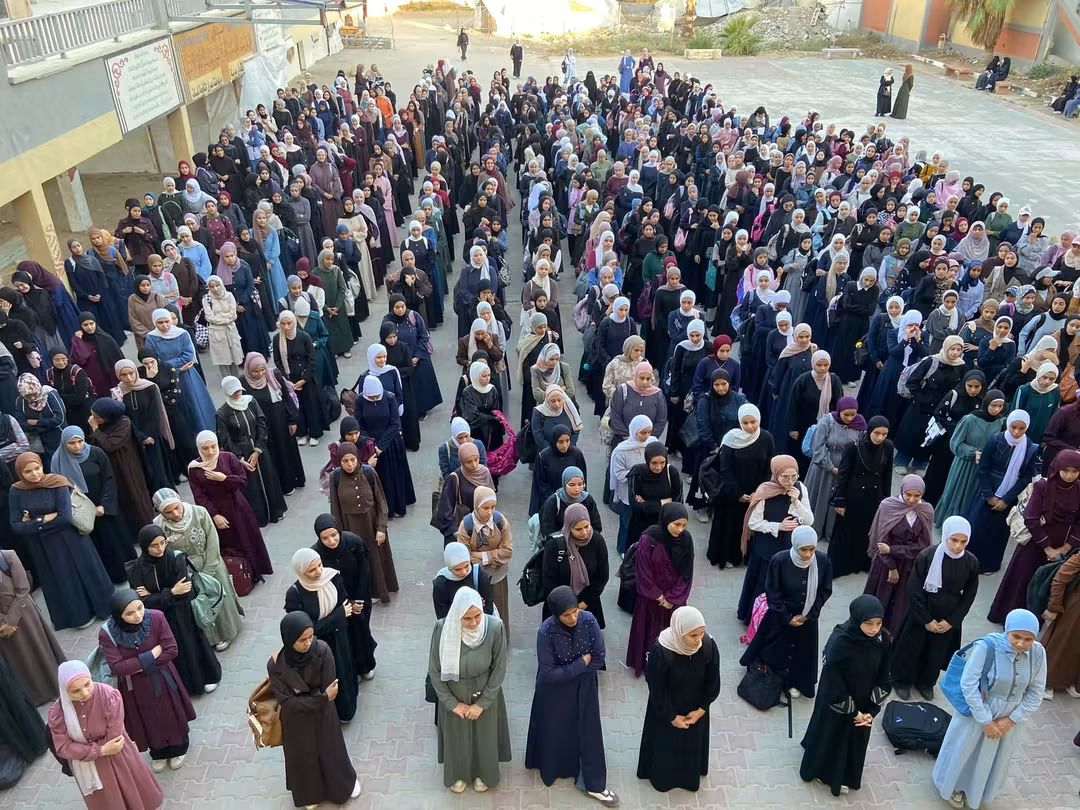
Among those present was a girl who had lost her father, another who had lost both her parents, and another who had lost her entire family. There were those who had lost their homes, their photographs, their memories, and the small things that once gave a house its meaning. And among them were those who had lost dreams they once believed they would live long enough to see fulfilled.
Yet, despite all of this, they had not lost the future.
Perhaps that is why the scene was greater than merely a return to classrooms.
In Gaza, education is no longer an ordinary path that takes a student from school to university and then into life. The very meaning of education has changed. When a school is destroyed, going to class becomes an act of holding on to life. When books disappear, searching for a notebook and a pen becomes a way of restoring order amid chaos. And when killing stalks children through alleys and streets, sitting before a teacher becomes a simple yet profound declaration: We want to live.
Here, a student does not begin the day at the entrance of a safe school, nor does she necessarily sit at a desk she has known for years. She may begin her lesson in a temporary place, inside a tent that does not fully protect her, with a book that survived the rubble, and with a heart carrying more fear than any child should ever have to carry.
And yet, she opens the book.
That small gesture, in a time like this, carries enormous meaning.
A human being does not resist death only by confronting it. Sometimes, we resist it by insisting on learning, remembering, and making plans for a tomorrow that has not yet arrived.
That is why the return of hundreds of thousands of students to education today was not merely a school event. It was a moment in which Gaza reclaimed a part of the image of itself that the war has tried to take away.
Nearly half a million students have returned to education.
Nearly half a million new attempts to open a window in a wall of rubble.
Nearly half a million children and young people saying, each in their own way: We may have lost so much, but we have not surrendered our future.
And as I write this testimony, sharing my own experience, I do not want to speak only of the schools that disappeared, the books that were lost, or the desks that became memories.
I want to record something else:
That education in Gaza has become an existential necessity—a form of resistance, and an image of resilience that the ongoing genocide has not been able to burn away.
And the student who walks to class today does not carry only a schoolbag. She carries with her her right to a future, the memory of those she has lost, and the dream of those who could not make it to tomorrow.
That is why, when I looked at those faces, I understood that some battles are not fought with weapons.
Some begin with a pen.
With a page.
And with a child opening her book, despite everything.