
Jock Tamson's Bairns
 So, we lost.
The important thing to remember is that we all lost, every one of us in Scotland. All Jock Tamsons's bairns, those who voted 'no' just as much as we who voted 'yes'. All of our futures are dimmed, all of our hopes of comfort and prosperity diminished, all of our security eroded. And we are luckier than they. Not for us the slow dawning realisation of how dreadfully, how catastrophically they have erred.
When the value of their homes collapses and they are in negative equity, they will know — for they knew that the United Kingdom government was promoting yet another unsustainable housing bubble — they will know they voted for that.
Is a currency union with fUK worth £126 Billion?
 Bear with me folks, I'm just thinking aloud. Address it as such.
UK debt is £1.4Tn; the cost of servicing that is £50Bn per year.
Scotland's population share of the debt — if we do the deal that seems to be proposed, of a population share of debt in return for a population share of assets, with the pound Sterling explicitly counted as an asset — is £126Bn. So if we got the same interest rate as the UK gets now, our servicing cost would be £4.5Bn per year, but we'd probably get less good terms so it would be a bit higher — say £5Bn.
Modelling settlement with a cellular automaton
I've written about modelling settlement patterns before; several times, actually:
- Populating a game world;
- Modelling the change from rural to urban;
- Modelling rural to urban, take two.
I had hoped to have the algorithm for Populating a Game World written by now, but I've been ill most of this summer and it hasn't happened. Instead, I've revived a rule-driven cellular automaton which I first wrote back in the 1980s; I've reimplemented it in Clojure, and used it to experiment with settlement. The results have been mixed.
The West Lothian Question, take two

Back in 1977 that famous old-Etonian, Sir Thomas Dalyell Loch, 11th Baronet of the Binns, famously asked a question which has troubled his party ever since.
The question, in his own words, was this: For how long will English constituencies and English Honourable members tolerate ... at least 119 Honourable Members from Scotland, Wales and Northern Ireland exercising an important, and probably often decisive, effect on English politics while they themselves have no say in the same matters in Scotland, Wales and Northern Ireland? Those 'honourable' members — better known here in Scotland as the 'feeble fifty' — have indeed had a decisive effect on English politics. It was with their votes that Tony Blair imposed tuition fees on English university students, foundation hospitals on the English NHS. I believe that it is true that Labour did not have a majority of English MPs on either of those votes — which affected only England.
Syria and Galloway
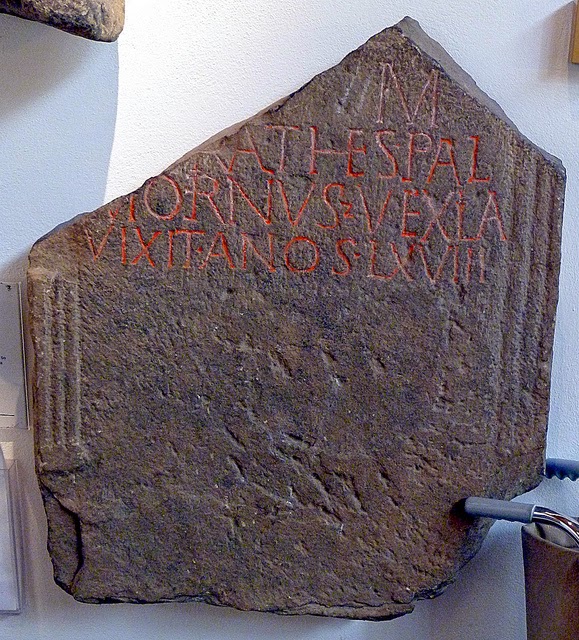
In these days when we're all listening on the news to the developments in Syria and Iraq, the emergence of the Islamic State, the conflict between Sunni and Shia, the plight of fleeing Yazidis and of the Syrian Christians, I was struck by this powerful essay by Robin Yassin-Kassab, exploring the historic links between Syria and Galloway.
Yes, of course there were Syrians (and also Nubians — people from what is now Libya and Morocco) on the wall. I've mentioned them before on this blog. And we know that at the end of their service, they were not sent home: instead, they were given grants of land locally to where they were stationed at the end of their service. So there were certainly Syrians and Nubians settled on what is now Northumberland and Cumbria, and their descendants are almost certainly still there.