
Living in the Winter Palace, part two
This is (now) a blog (mostly) about building a house. But it's a blog about my life, and my life impacts on building the house. So I'm going to digress briefly; bear with me, it is relevant.
Having spent a great deal of my adolescence in and out of mental hospital, I have an intense dislike of psychiatric drugs. In my adult life, despite three major breakdowns, I'd always refused them; until the autumn of 2010, when, out of desperation, I asked my doctor for anti-depressants. They got me through the crisis of having to sell my home, but I stopped using them as soon as I felt I could. However, in November of 2011 things were worse. I had the shell of my new home up, but I was out of money, and my ability to cope with strangers was almost nil. I again asked my doctor to prescribe anti-depressants. I went, almost inarticulate, to the Citizens' Advice Bureau to ask for help applying for social security benefits; the volunteers there were extremely patient with me, and, in the course of talking to me, asked what I was doing for food. I admitted that I didn't have any, and they gave me a food parcel — including, bless them, food for the cats. I accepted it, gratefully. That's as low as I've ever been. I don't want to go there again; although, having said that, swallowing my pride and going to the Citizens' Advice was a positive step in itself.
Living in the Winter Palace, part one
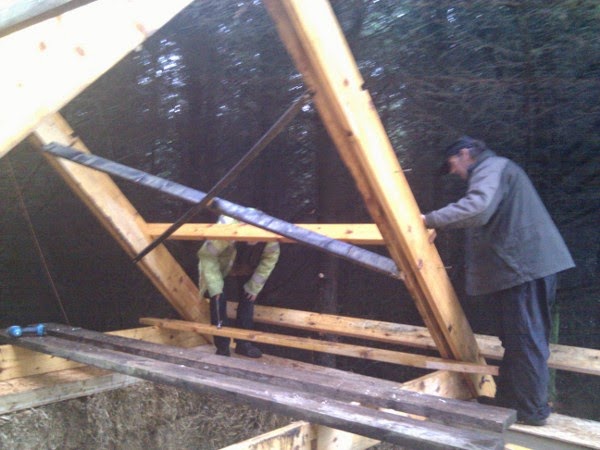
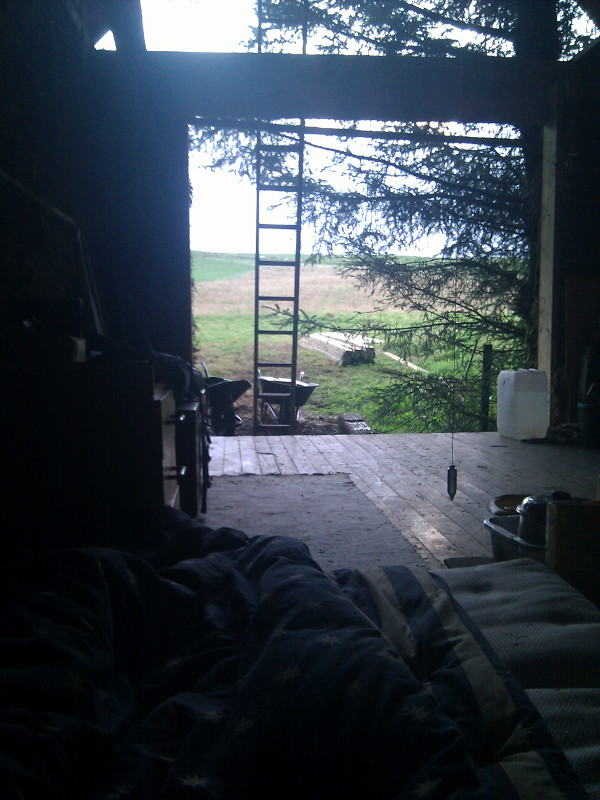
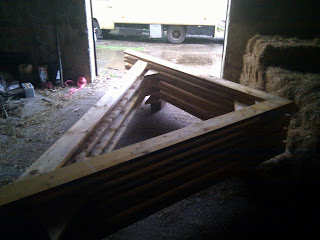
It's a long time — four and a half months — since I last blogged about this house. Then, it was three walls of raw straw bales covered with the skeleton of a roof covered by tarpaulins. Now, I'm sitting in my bed in my upstairs bedroom, leaning back against the panelled wall. Downstairs, in the kitchen, a kettle sits on the gas hob — it isn't worth lighting the big wood stove to boil a kettle. But when I want a hot, deep bath, the stove will heat it for me in a couple of hours.
Although it's a cold morning outside, the thick insulation in the roof, walls and floor mean I'm cosy here inside. And as I sit here and look around at my home, I know not only that I designed it and planned it, but that every piece of wood, every pipe, every wire in the house was cut and fitted by me. That isn't to say I haven't had help, of course. I've had lots of help. I have wonderful friends. And I'm grateful to them. But this is still, very much, a home-made house: my home made house.
State of Play
I last posted here about my life and the state of the farm in May; it's time to post again. It's autumn, and I have now spent five months living in my simple tree house. And actually, that's mostly been good. I've been, over all, much more comfortable than I expected, and the cats have certainly liked it. But the tree house — my 'Summer Palace' — was always only intended to be a temporary structure. I was going to live here until I'd got planning permission to build the house I wanted. Well, I haven't got planning permission — not because it's been refused but because it's all taken much longer than expected.
The summer has been, as you'll know, both wet and cold, but for me it's been a mostly contented time. My home — not just my little shelter, but my wood and my whole croft — is exceptionally beautiful. It's also a very calm and quiet place, except for the one weekend of the year they hold a rock concert just beyond my wall. I've had a good hay harvest, and still have barley standing which I hope to harvest soon.
Storm
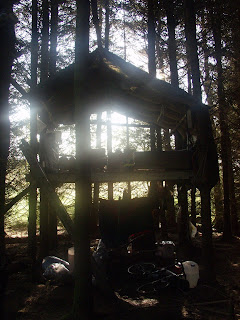
My summer residence is supported on seven spruce trees. In the time I've been here — since early May — the BBC have twice forecast hurricane force winds. The first time, I abandoned ship — but they exaggerated, it was only storm force. This time, I haven't abandoned, and it's now too late to do so. The wind on the hilltop is too high to safely evacuate the cats. I suspect, and hope, that the BBC are exaggerating again, but earlier this morning I described the wind as the second strongest I'd ever experienced. That's no longer true.
It literally is not possible for a grown man to stand upright in the gusts on our hilltop now. I know that, because I've just been there. So I'm going to have to stay put. On the plus side, my wood shows no evidence at all of windfall trees. So far as I can see, no tree of the present generation has ever blown down. And although I have thinned a little, I've been careful to preserve the green edge of the wood — I really think it's wind-firm.
Plan B
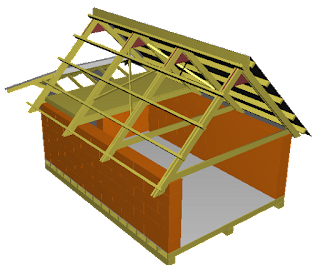
Of course Plan A is to get planning permission. Of course Plan A is to live in a proper, legitimate house, pay council tax and have my rubbish collected in bins. But that may not happen. It, actually, may not happen for three reasons. Firstly, and very probably, planning permission may simply be refused. That is actually pretty likely — I probably have less than 50% chance of getting planning permission anyway.
Secondly, planning permission may be granted but it may be granted too late. I must have something considerably more comfortable and weatherproof than the Summer Palace before winter; neither my mental nor my physical health would stand up to a winter spent literally out of doors. So if I haven't got planning permission by mid-July I have to go to plan B anyway.