Review: Penric's Demon
By: Simon Brooke :: 2 May 2026
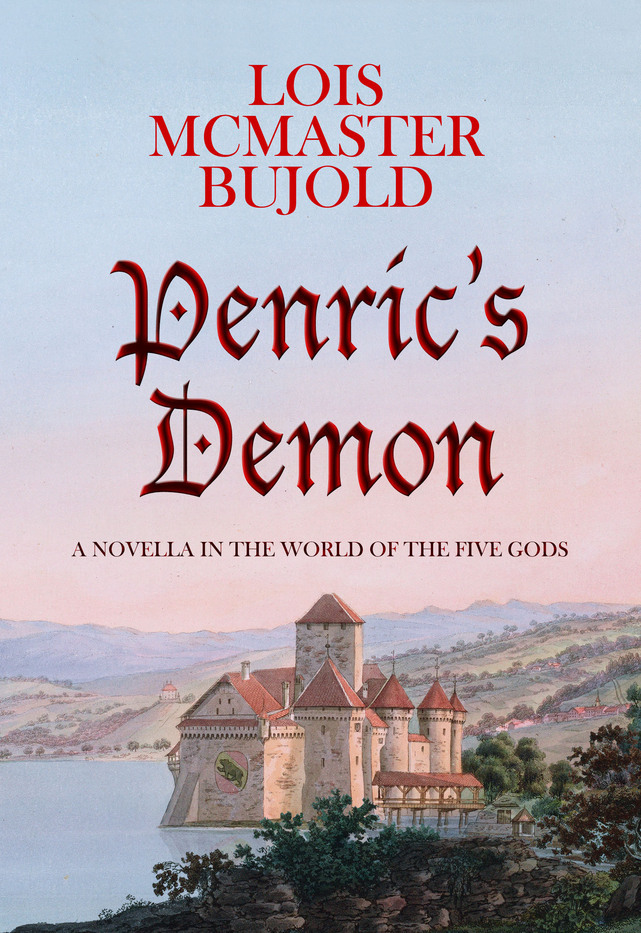
What does one say about Lois McMaster Bujold's Penric series?
Bujold is an uneven writer. I'm not an admirer of her science fiction. But her novel The Curse of Chalion is a genuinely superb book, and introduces a world — closely based on an altered Medieval Europe — with a genuinely interesting and original theology. The third novel in the series, The Hallowed Hunt, is in the same class: not quite as startlingly innovative, but introducing many new and interesting consequences of her initial theological scheme, and extraordinarily well executed.
I don't think the Penric novellas are of the same quality. They're set in the same world; that world is still compellingly described; the characters are still well drawn and interesting. But this is lighter fiction, not, I think, quite as serious in its intention. The nearest thing I can think of to illustrate the level at which I think it is pitched would be Arthur Conan Doyle's The Adventures of Sherlock Holmes.
To consider more modern fiction, there is a parallel to Penric in Ellis Peters' Cadfael novels: they too concern a man of the church, are episodic, in each episode a mystery to solve (as there is in most, but not all, of Penric's), with a well developed setting in a historical European landscape, and although Penric's stories are in a parallel, not-quite-historical world, of roughly similar date.
I've reread part of one of the Cadfael novels while writing this review, to compare. Peters' work, of course, touches real history, and her research on it is detailed; but she tends to narrate it in plodding chunks of exposition. Bujold, not being tied to real history, does not have to do this; but she tells equally voluble imagined history in a much more fluid and engaging style. She is a better writer than Peters, and a less pedestrian one. I feel that on a level of seriousness, Penric and Cadfael march shoulder to shoulder; both are pleasant, light series. But on the level of entertainment, I feel Penric has the edge. But if you enjoy Cadfael, I think you will enjoy these.
The Penric stories are quite clearly novellas, substantially longer and richer the short stories of the Sherlock Holmes series but shorter than the Cadfael novels; but like each of those series they follow the same core characters (in this case the sorcerer-priest Penric and his companion demon Desdemona) through distinct episodes in a long, consistent, career; and, in the process, build incrementally a cast of interesting returning side characters.
As in the Cadfael stories, there are few real villains; and, as in the Cadfael stories, bad things never happen to sympathetic characters. It's all fairly cosy. Penric is capable of occasional extraordinary feats of defensive magic, but is extremely parsimonious in the use of this power.
Magical physics is well handled; the magic has a clearly defined theory which is consistent with the world's theology; and it has real costs and limitations. It's also rare. Demons are rare in the world, and old demons even rarer; although in principle immortal, they are in practice quite vulnerable. To survive in the world they need a physical host, but more: to be sentient, they need a sentient host. Demons gain ability with knowledge and with experience, so older demons are more magically powerful; and Desdemona is an old demon.
But the sorcerer's magical power depends not only of the power of their demon companion, but also on the quality of the relationship between sorcerer and demon. Penric meets with Desdemona entirely by chance, but their relationship, once established, is clearly very warm — the warmth of it glows out from Bujold's prose. So as a pair, Penric and Desdemona are exceedingly powerful.
However, their magic is not an endless get-out-of-jail-free deus ex machina. They do most of their work by the practical and mundane application of intelligence, just as Holmes and Cadfael do.
This first episode, Penric's Demon, introduces and treats of the meeting between these two characters. It is set in the world's analogue of Switzerland, where Penric has been raised as the younger son of a minor and impoverished noble house, whom we first meet as he sets out on a journey to propose to the daughter of a (comparatively) rich merchant, but is interrupted on the way.
This is a very enjoyable yarn, told with good pace, set in a well realised and enjoyable world. It won't stretch your brain or require close attention, but (I think) you will enjoy it.
The rest of the series? There's an extremely tiresome romance in the middle of it which, to my mind, badly mars two of the stories; but on the whole, a good series. I've read every one of the fifteen currently published episodes, regret none, and will read the next. And, while there are two which I did not find nearly as readable as the others, I would nevertheless recommend reading them, because the later stories, which are enjoyable, build on them.
A side note: I've read Penric exclusively on Kindle, on an e-reader screen. Previously, I've not greatly liked the e-reader, although mine is of the first generation sold in Britain and is now I think thirteen years old. But with deteriorating eyesight it's been many months since I read fiction for pleasure; and reading these on the Kindle I've found, to my surprise, that I once again can.
Which is something of an embarrassment in this age when Amazon has made it extremely clear that it is an evil empire! I shall need to find myself an open source reader (or a way to flash my Kindle with an open source operating system); and another source of reasonable fiction in e-reader format.