The 'everyone dies' event comes home
By: Simon Brooke :: 15 July 2026
Edited 13th August to add: This essay is misleading and alarmist. It was written in good faith, but I have since researched and done the maths to more fully explore the probable wet bulb temperatures given the Met Office's scenario, and my assumptions were wrong. This work is documented here.
On 23rd June, the Meteorological Office published a blog post in which they claimed that 'UK could see 45°C by 2056'. As you'll know, I've blogged before of the issue of excessive heat events in our changing climate. So the fact that they projected temperatures above 35° Celsius without commenting on humidity triggered my attention.
The projected weather map (data from Meteorological Office)
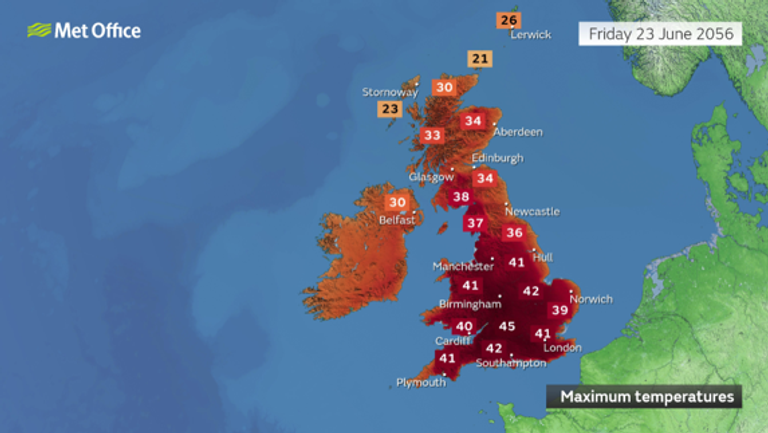
I'm preferring links to the Meteorological Office's published information over links to other authorities in this post for reasons which will become apparent later...
Why Britain is wet
Britain sits to the east of a large ocean. Because of the Coriolis effect, average wind flow has a westerly bias irrespective of climate, and, additionally, for at least the period during which people have been navigating the seas and leaving records, the prevailing winds at our latitude in the north Atlantic have been westerly.
Throughout recorded history, there have been substantial areas of the tropics where prevailing winds have been easterly, overcoming the Coriolis effect, because of patterns of climatic circulation. I don't have the theoretical knowledge to say confidently that the prevailing wind over Britain could not change as a result of the warming global climate. But I've seen no projection, either scientific or otherwise, to suggest that it will.
Additionally, wind circulates clockwise around a high pressure area in the northern hemisphere, so if the centre of the area is to the south of us (high pressure often in summer ridges up to us from the Azores, and thus the centre is to the south of us) the airflow will be westerly. So wind in summer heatwaves will tend to be off the sea. Only if the centre is north of us will it be easterly, for example when the high is centred over Scandinavia (which does happen but is rarer).
What is certain is that prevailing wind off the sea has meant that Britain's air is relatively humid. Of course, it is particularly humid because the Atlantic Meridional Overturning Circulation means that the surface temperature in the temperate north Atlantic is warmer than one would otherwise predict for our latitude. There is evidence that this circulation is slowing and may stop altogether, in which case it might be reasonable to project that Britain would become somewhat less humid. I don't know, I haven't studied this. The Meteorological Office at least ought to have done so.
Of course, if the circulation does stop, that will cause other changes to the weather which will call into question the viability of a dense human population in Britain, but that is not the subject of this essay.
The upper climatic limits to human survival
People maintain a homeostatic temperature by sweating. If our body temperature rises only a few degrees above normal, proteins in our tissues start to denature, leading quite rapidly to death.
Sweat cools the body by evaporating. It can evaporate only if the air around the body can absorb moisture; if the air is already saturated, nothing (more) can evaporate. The humidity at which air becomes saturated varies with temperature. I covered this in more detail in my essay 'The Everyone Dies Event Class'.
Maximum survivable temperature, by humidity
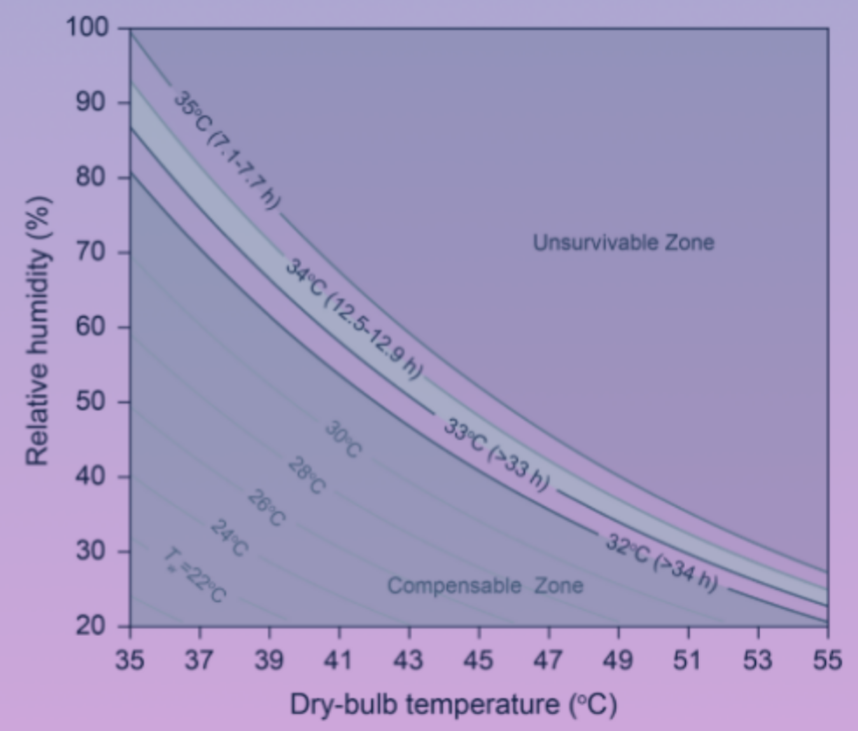
The typical daily high humidity in England in July is around 90% (data from Current Results). Figures for Scotland are similar.
The average humidity levels in July for cities and towns in England
| Place | High | Low |
|---|---|---|
| Birmingham | 90 | 60 |
| Bournemouth | 93 | 61 |
| London | 93 | 60 |
| Manchester | 88 | 63 |
| Plymouth | 90 | 71 |
| Ramsgate | 90 | 65 |
Relative humidity vs absolute mass of water in the air
In my initial draft of this essay, I made an error of understanding, which led to the essay being substantially more alarmist than it ought to be.
Essentially, I assumed that relative humidity was a measure of the mass of water in a volume of air, and consequently if you took a sealed can of air and heated it, the relative humidity wouldn't change. This is false. The absolute mass of water per volume of air is termed 'absolute humidity', and the relationship between relative and absolute humidity is complex.
However, what's important is this. If you take that imaginary sealed can of air, and fit it with an imaginary valve at the bottom through which liquid water can pass out but through which gas cannot pass in either direction, and put it through a heating/cooling cycle, any water that the air cannot carry at the coolest point in the cycle will precipitate out and escape through the valve; and consequently the maximum absolute mass of h2o molecules in the can after a complete cycle will be at most that mass which the air can carry at the coolest part of the cycle.
But the sealed can is a poor model because one of the things that's happening as air warms is that it expands. So, substitute for the sealed can, a sealed bag of diaphanous (but still gas-impermeable) fabric, with the same valve as before. As the air in the bag heats and cools, as before, water precipitates out at the coolest point of the cycle, and is lost. So as the air warms again, it has not as much water to carry as before.
However, and here's the tricky bit: as the air in the bag warms up, it also (for a given pressure) expands. So if we started with a cubic metre of air at the coolest point of the cycle, then by the warmest part of the cycle we would have more than a cubic metre of air. The h2o molecules would be randomly distributed through this larger volume. But absolute humidity of air is measured as grams per cubic metre, so as the air expands, the absolute humidity drops — without any h2o molecules ceasing to exist; they have simply dispersed, with the rest of the air molecules — into a larger volume.
My understanding is that there is about one percent expansion for every six degrees Celsius, in the range we are interested in, although I don't have a good reliable source for this.
There's another thing that air does as it warms, however, and that is it rises, thus drawing in cooler air from round about; and in Britain that is typically from the sea ('onshore breezes'). That air is wet.
Is there a problem?
The variance between daily minimum and daily maximum temperatures in central England, in summer, is about 9° Celsius. I don't see why that variance should change much as the absolute values rise, we're a long way from zero Kelvin. If there is a change, I would expect it to be a slight increase, but hardly a significant one (again, this is not my discipline, I could be wrong).
A westerly wind brings air in off the sea. If you have a sea mist at dawn, that's the air fully saturated, 100% humidity. The maximum water burden air can carry at 35° C is 39.58 grams/metre3, which is lethal. But if the maximum daytime temperature is going to be 45° C, and the daily range is 9° C, then the minimum overnight temperature is 36 °C, at which temperature the water burden it can carry is 41.69 g/m3. As the air heats, that water will not precipitate.
Early morning sea mist does happen in summer heatwaves; it has been reported in south west England in this year's heatwave.
The air volume will increase by approximately 1.5% over 9° C, so the water burden of one cubic metre of that air at 45° C will be ballpark 41 g/m3. That's equivalent to a relative humidity of 62.74%. And that's well into the unsurvivable zone.
To be fair, the Meteorological Office, in their second response, say that in their modelling they were projecting that the hot volume of air would have come in from Spain and France, and would have heated over land, not over water; and would thus be drier. But if the high pressure area were west of Britain, dragging air up from the area west of the Azores, as is more normal, that air would be wet. The air there currently averages 26° C in July, as it does in Birmingham. But what we're considering here is not an average event but an extreme event; and if an extreme event in mid century can raise the temperature in Birmingham to 45° C, I don't see why it couldn't do the same west of the Azores. After all, a high centred on the Azores would be pulling air off the western Sahara, which I imagine might get quite warm.
An Everyone Dies event?
If the only way to get a very hot air mass over Britain were via southern Europe, then this would not be an 'everyone dies' event; and the event the Meteorological Office were considering was an event where the air did come from southern Europe. But classically, hot weather in Britain is associated with the Azores High, and that air does not come via Europe. So, unless there's some further information I don't yet have, there is a clear risk of a major 'everyone dies' event, at least for central southern England.
Even widespread installation of air conditioners1does not greatly alter that projection, because
- All those air conditioners, pumping heat out of the buildings, would raise the ambient temperature still further; and
- We don't have grid capacity to power them.
However, of course, in extreme heat people will tend to gather (and will probably be advised to gather) in buildings where there's good air conditioning (e.g. hospitals, chilled warehouses, some office buildings) and in places which are protected from extreme heat (e.g. railway tunnels, crypts, cellars).
But if there's a prolonged heatwave — the Meteorological Office blog is talking about one lasting a fortnight, which is more or less what we have as I write this — then the logistics of feeding and sanitation for large number of people crowded into spaces many of which were not designed to house large numbers of people become problematic; and any grid failure, when large numbers of people are crowded into air conditioned buildings, would leave those people unprotected. Grid failures are common in heatwaves.
There's also the point that modern cities, because of their structure and design, tend to be significantly warmer than their surrounding environment, and are also where the population is most dense; so providing shelter for city populations will be especially difficult.
So while shelters may help protect many people, it seems to me unlikely that they could protect a significant proportion of the population.
Checking my understanding
But do I understand this correctly? The only circumstance which would alter my conclusion would be if the Meteorological Office has evidence to suggest that Britain's summer humidity levels will fall by more than one third by that time. It's possible that that's true; I certainly don't have the theoretical knowledge to say that it's false. So, I asked them.
Dear Met Office
I've read your blog UK could see 45°C by 2056, scientists reflect on 1976 heatwave anniversary, published this week, and note that it does not give figures for projected humidity.
As you will know, human beings die in an environment with a wet bulb temperature above 35° C. At 45° C, that implies a maximum survivable humidity of about 55%; at 41° C, a maximum survivable humidity of about 68%. The humidity here in southern Scotland yesterday, in summer heatwave conditions, had a low of 77%, and a high above 90%.
Looking at your projected map, with my current understanding of probable UK summer humidity, it would seem that you are forecasting that in such an event, everyone in the triangle bounded by Exeter, London and Sheffield will die; and if that is what you are forecasting, then I think you have some public responsibility to say so.
You may, of course, have some reason to believe that, while temperatures will rise in future summers, humidity will decrease. But if so I would really appreciate a reference to a document in which the reasons for this belief are laid out.
Yours sincerely
Simon Brooke
The Meteorological Office reply
And their reply?
Dear Simon,
Thank you for your email.
The temperatures featured in the blog are taken from a plausible future climate scenario designed to help illustrate how heat extremes in the UK could change in a warming climate. The scenario is based on temperature projections and was not intended to represent a comprehensive assessment of all meteorological variables or associated health impacts.
Humidity levels during future extreme heat events cannot be assumed to remain the same as those experienced during present-day weather events, and the scenario should not be interpreted as a forecast of unsurvivable conditions. Rather, it is intended to highlight the increasing likelihood and severity of extreme heat events and the importance of preparing for their impacts.
For further information on how climate change may affect temperature, humidity and heat stress in the UK, you may find the UK Climate Projections (UKCP)https://www.metoffice.gov.uk/research/approach/collaboration/ukcp resources helpful.
Kind regards,
This struck me as a non answer. (There is now a fuller answer from them, which I quote below.) 'Humidity levels during future extreme heat events cannot be assumed to remain the same as those experienced during present-day weather events', they write. No, indeed they can't; that's why I wrote to the Meteorological Office to ask the question. But unless they change dramatically, that is a 'forecast of unsurvivable conditions.' Are humidity conditions expected to change dramatically? They don't say, except to refer me to their UK Climate Projections resource.
The key document, as far as I can see, in that collection is this one. It projects, for the UK, temperatures (page 96); precipitation rate (pages 97-98); wet day frequency (pages 99-100); average temperature and precipitation by month (page 101); winter and summer temperature extremes (page 103); precipitation extremes (page 104); precipitation intensity (page 105); changes in air temperature by season (pages 108-109); precipitation by season (pages 110-111); and so on.
Many of these projections clearly have a relationship to humidity. It is possible that an experienced meteorologist may be able to derive conclusions about humidity from this data. But I as a lay person cannot, and the document contains no explicit projections of UK summer time humidity.
As far as I can find, the nearest thing to an answer to my question is this paragraph, from page 111, discussing changes in summer precipitation:
Changes in summer precipitation (Fig. 4.8d) reveal a consistent drying response in RCM-PPE in most regions. The only exceptions are some coastal areas of Northern Scotland, where the high responses shows the potential for some small increases. The UK average reductions are 41% (low), 26% (central) and 18% (high). Rajczak and Schär (2017) find a smaller level of drying in the EuroCordex ensemble mentioned above. In this, spatial average changes for the British Isles revealed that three simulations gave a small increase (maximum value 10%), and twelve of the fifteen simulations simulated a drying. However, the largest reduction was only 28%
There's further discussion of summer drying on pages 117-118, on page 124, on page 133 and (further into the future) on page 137; I don't think these add significant new information that I can interpret.
In each case 'drying' is commented on in relation to precipitation, not humidity, and while the two must be linked, it is not obvious to me that the link must be either direct or linear. I'm certainly familiar with days of very high humidity when it does not rain.
However, if one interprets 'drying', here, as meaning lower humidity, then yes, there may be a reason to believe that summer humidity will drop. But, crucially, if that last sentence should be interpreted as saying the maximum probable reduction in humidity is 28%, then 28%, given the projected temperature map with which we started, is not enough to prevent an 'everyone dies' event (although it would be limited to an area covering Bristol-London-Birmingham).
On page 151 of the document we find
The ensemble-average drying for England reaches 50% by the end of the 21st century, compared with a median reduction of about 40% in Strand 1
which, again, if we interpret 'drying' to mean reduction in humidity, would make 45° Celsius (just) survivable — but that's by 2099, by which time those who died in the summer of 2056 are already long dead, if (probably) not buried. Because who will be left to bury them?
The second Meteorological Office response
I sent an early draft of this essay to the Meteorological Office for comment, and received this:
Higher humidity makes it harder for sweat to evaporate and cool the body, increasing heat stress. If temperatures of 45°C were combined with relative humidity anywhere near 50%, the resulting wet-bulb temperature would be around 35°C, which is an exceptionally dangerous combination of heat and humidity. Research suggests that severe heat stress can occur well below a wet-bulb temperature of 35°C, particularly for vulnerable people, while 35°C is often discussed as a theoretical upper limit of human survivability.
However, whilst the 2056 forecast shows temperatures of 45°C, the relative humidity is almost certainly not as high as 50%. A 50% relative humidity would require a dew point temperature of 32°C, which is approaching the global all-time record (35C) and seems incredibly unlikely for the UK, despite extreme temperatures into the 40s. Extreme temperatures into the 40s are more likely to occur when the air is dry rather than humid. For example, when 40°C was recorded at RAF Coningsby in 2022, the dew point was 9°C, which gives a RH of around 16%.
The recent heatwave at the end of June was significantly more humid than the July 2022 (40°C) heatwave. And that's one of the reasons we were warning of similar or worse health impacts. But it's also possible that the higher humidity of the atmosphere placed a cap on maximum temperatures - with widespread mid 30s and isolated >37°C recorded.
In practice, the most likely route to 45°C in the UK would be through a very hot, relatively dry continental airmass rather than a combination of extreme heat and extreme humidity. Nevertheless, we know that temperatures of 45°C in the UK would be dangerous even for fit and healthy people, whatever the humidity.
A policy wonk friend, asked to review this, commented: "The super-rich spending three months of the year inside their climate controlled bunkers while the poor sous-vide outside their air vents" is a possible future that isn't "everyone dies". It's not a GOOD future...but it does seem to be the one that we're rushing to.
↩