On Local Government in Scotland
By: Simon Brooke :: 23 October 2026
On Local Government in Scotland
[This is another in a sequence of essays broadly in response to the Scottish Government's extremely hasty and ill-conceived plan for local governance reform. It is not yet finished.]
For years, when arguing about the parlous state of local government in Scotland, I have said that the best thing to do would be to just devolve all powers (including local tax raising powers) down to community councils, and work from there. I've said this, half in jest, intending to provoke.
But last month I wrote an essay analysing local government size — municipality size — across Europe, and it's made me revise that 'provocative' thought.
Brief recapitulation: there are five EU countries which have an average municipality population less than 4,000; fourteen with an average less than 8,000. Across the whole of the EU, the average municipality population is 22,455. In Scotland, a massive outlier, it is currently 173,341. As I pointed out in that essay, France, our partner in the Auld Alliance, has one thousand times as many local authorities as we have.
It isn't just Europe, either. The average population of a local government entity in the USA is 3,762 — almost identical to a Scottish community council; for Canada it's 6,102. Scotland is not just a significant outlier in Europe; it is one of the most centralised 'democracies' in the entire world.
So what about our community councils? How do they compare in size to our European neighbours' municipalities? Here's the data, taken from Scottish Government figures:
| Local Authority | Population (2011) | Population Percentage of Scotland | Area (sq/km) | Area Percentage of Scotland | All Community Councils | Active Community Councils | Percentage of Community Councils that are active | Population per Community Council | Population per active Community Council | Area per Community Council (sq/km) | Area per active Community Council (sq/km) |
|---|---|---|---|---|---|---|---|---|---|---|---|
| Aberdeen City | 223,000 | 4.20% | 186 | 0.24% | 30 | 21 | 70% | 7,433 | 10,619 | 6.20 | 8.80 |
| Aberdeenshire | 253,000 | 4.80% | 6,313 | 8.10% | 71 | 71 | 100% | 3,563 | 3,667 | 88.90 | 91.50 |
| Angus | 116,000 | 2.20% | 2,182 | 2.80% | 25 | 24 | 96% | 4,833 | 5,043 | 90.90 | 94.90 |
| Argyll and Bute | 88,000 | 1.70% | 6,908 | 8.86% | 56 | 54 | 96% | 1,571 | 1,630 | 123.40 | 127.90 |
| Clackmannanshire | 51,000 | 1% | 159 | 0.20% | 9 | 9 | 100% | 5,667 | 5,667 | 17.60 | 17.60 |
| Dumfries & Galloway | 151,000 | 2.90% | 6,426 | 8.25% | 107 | 85 | 79% | 1,411 | 1,776 | 60.10 | 75.60 |
| Dundee City | 147,000 | 2.80% | 60 | 0.08% | 19 | 3 | 16% | 7,737 | 49,000 | 3.10 | 19.90 |
| East Ayrshire | 123,000 | 2.30% | 1,262 | 1.62% | 35 | 30 | 86% | 3,514 | 4,100 | 36.10 | 42.10 |
| East Dunbartonshire | 105,000 | 2% | 174 | 0.22% | 13 | 12 | 92% | 8,077 | 8,750 | 13.40 | 14.60 |
| East Lothian | 100,000 | 1.90% | 679 | 0.87% | 20 | 19 | 95% | 5,000 | 5,263 | 34 | 35.70 |
| East Renfrewshire | 91,000 | 1.70% | 174 | 0.22% | 10 | 10 | 100% | 9,100 | 9,100 | 17.40 | 17.40 |
| Edinburgh | 477,000 | 9% | 263 | 0.34% | 46 | 42 | 91% | 10,370 | 11,357 | 5.70 | 6.30 |
| Eilean Siar | 28,000 | 0.50% | 3,056 | 3.92% | 28 | 25 | 89% | 1,000 | 1,120 | 109.70 | 122.80 |
| Falkirk | 156,000 | 2.90% | 297 | 0.38% | 23 | 18 | 78% | 6,783 | 8,667 | 12.90 | 16.50 |
| Fife | 365,000 | 6.90% | 1,325 | 1.70% | 106 | 84 | 79% | 3,443 | 4,345 | 12.50 | 15.80 |
| Glasgow City | 593,000 | 11.20% | 175 | 0.22% | 101 | 77 | 76% | 5,871 | 7,701 | 1.70 | 2.30 |
| Highland | 232,000 | 4.40% | 25,684 | 32.96% | 156 | 152 | 97% | 1,487 | 1,526 | 164.50 | 168.80 |
| Inverclyde | 81,000 | 1.50% | 160 | 0.21% | 11 | 9 | 82% | 7,364 | 9,000 | 14.60 | 17.80 |
| Midlothian | 83,000 | 1.60% | 354 | 0.45% | 17 | 17 | 100% | 4,882 | 4,882 | 20.80 | 20.80 |
| Moray | 93,000 | 1.80% | 2,238 | 2.87% | 20 | 16 | 80% | 4,650 | 5,813 | 111.90 | 139.80 |
| North Ayrshire | 138,000 | 2.60% | 885 | 1.14% | 17 | 11 | 65% | 8,118 | 12,545 | 52.10 | 80.50 |
| North Lanarkshire | 338,000 | 6.40% | 470 | 0.60% | 80 | 38 | 48% | 4,225 | 8,895 | 5.90 | 12.40 |
| Orkney Islands | 21,000 | 0.40% | 990 | 1.27% | 20 | 20 | 100% | 1,050 | 1,050 | 49.50 | 49.50 |
| Perth and Kinross | 147,000 | 2.80% | 5,285 | 6.78% | 52 | 46 | 88% | 2,827 | 3,196 | 101.70 | 114.90 |
| Renfrewshire | 175,000 | 3.30% | 262 | 0.34% | 26 | 22 | 85% | 6,731 | 7,955 | 10 | 11.90 |
| Scottish Borders | 114,000 | 2.20% | 4,732 | 6.07% | 67 | 65 | 97% | 1,701 | 1,754 | 70.60 | 72.80 |
| Shetland Islands | 23,000 | 0.40% | 1,467 | 1.88% | 18 | 18 | 100% | 1,278 | 1,278 | 81.50 | 81.50 |
| South Ayrshire | 113,000 | 2.10% | 1,222 | 1.57% | 29 | 27 | 93% | 3,897 | 4,185 | 42.10 | 45.30 |
| South Lanarkshire | 314,000 | 5.90% | 1,772 | 2.27% | 58 | 34 | 59% | 5,414 | 9,235 | 30.60 | 52.10 |
| Stirling | 90,000 | 1.70% | 2,187 | 2.81% | 43 | 42 | 98% | 2,093 | 2,143 | 50.90 | 52.10 |
| West Dunbartonshire | 91,000 | 1.70% | 159 | 0.20% | 17 | 10 | 59% | 5,353 | 9,100 | 9.30 | 15.90 |
| West Lothian | 175,000 | 3.30% | 428 | 0.55% | 40 | 37 | 93% | 4,375 | 4,730 | 10.70 | 11.50 |
The answer is that the average population of a Scottish Community Council is 3,864; which is larger than the average population of a municipality in Czechia, the Slovak Republic, France, Hungary, or Cyprus. By European standards a Scottish community council would be a small municipality, but not an absurdly or pathologically small one.
If we were to say that we would devolve all powers down to community councils, and then allow each community council, if it wished to (by popular vote), to amalgamate with at most three others, we would end up with municipalities which were very much of the world average size. It works everywhere else, why shouldn't it work here?
Objections
Community councils are useless
Yes, most community councils are useless. They're designed to be useless. They have absolutely no powers, and absolutely no revenue. They are legally prevented from engaging in activities which would generate revenue. They are fiscally prevented from engaging in any activity which would benefit their constituents. They cannot do anything independently, and this is by design. They have no resources to enable them to collaborate with neighbouring communities, and no powers to do anything if they had.
Which is why they need powers, including tax raising powers, and powers over planning, education, environment, roads.
Community councillors are useless
This is just the same objection as the one above. Community activists who want to make change in their communities, to improve their communities, do not want to get bogged down in a talking shop with no powers. Instead, they run local community interest businesses and projects, over which there's limited democratic control. So we have a democratic institution with no agency, and a not for profit businesses with limited democratic oversight, very often sharing the same geographic territory and even some of the same members. It's a mess. No wonder the people with energy and vision avoid it.
Which, again, is why they need powers, including tax raising powers, and powers over planning, education, environment, roads.
Full disclosure, I am (proudly) a community councillor.
No one votes in community council elections
Well, of course not. Community councils have no powers, are useless, don't affect the amount of tax you are charged of the services you receive, what on earth is the point of voting for them?
We can't afford to pay all those councillors
No, of course we can't. But why would we? Councillors across Europe are generally not on full time salaries; they get expenses, or a per-meeting allowance, or nothing. And that's actually fine, because if you have a sensible sized municipality you meet your constituents in the street, or in the local shop, café or pub, every day. You can walk or cycle to the one or two meetings you have to attend each month; even a Highland community council area (average area 164.5 square kilometres) has a radius from its centre of only about eight km, or roughly five miles.
One or two meetings a month? Well, how much business do you think there is to transact, how many planning applications, how many policy decisions, how many contracts to let, do you think there are to be made in an area the size of an average European municipality? A councillor will have one council meeting a month, one or two sub-committee or liaison meetings a month. They will never travel long distances. It isn't onerous. A per-meeting allowance seems to me sensible, since it rewards attendance, but I don't think it would be vital. And of course, the meetings would generally be in the evenings — as community council meetings generally are — because most of the councillors will be doing a job of work to earn a living in the daytime.
The professionalisation of our political class is a very odd decision. It is the core of the concept of representative democracy that representatives serve at the pleasure of their electors; they have, and should have, no expectation of security of tenure. If they are voted out at an election, there is no appeal.
Yet depriving someone of their livelihood is not something that should be done lightly. People choose not to go into local politics because they will have no job security, no career progression; and so we lose good candidates, and we lose the training that service in local government provides for those who might later serve in national government. We would have a much more healthy political life is our councillors were plumbers or school teachers or accountants or parents first, and councillors only second.
Not everything can be done at a very local level
Well, indeed not. A village cannot, generally, on its own, support a secondary school, or a further education college, or an electricity grid (although that may be changing), or a swimming pool; and it may be undesirable to run (for example) a social work department at a village level.
But there is such a thing as co-operation. Municipalities can co-operate together to operate services that serve a group of communities. It's possible that one group of municipalities would wish to set up a single co-operative enterprise to provide a broad range of services, whereas others might wish to have separate transport, education, social services, water and sewerage co-operatives, for example. I strongly believe that such decisions, too, should be local.
Benefits
Locality
Do you know who your councillors are? Well, do you? When did you last meet one?
The council ward I vote in is larger than the five smallest independent European countries put together. If I wanted to attend a meeting of Dumfries and Galloway council (my 'local' council), I would have to cycle a round trip of fifty miles, since I have no car and the buses are not at all reliable.
To visit the planning office, or make almost any other interaction with the council, I have to travel the same distance. This makes democratic and civic engagement virtually impossible.
One size doesn't fit all. Decisions which are right for one place are wrong for another. A councillor from Langholm (64 miles east) or Drummore (65 miles west) should not be deciding what houses should (or should not) be built on Auchencairn's Main Street, or whether our primary school should remain open, or how the speed limit through our village should be enforced. Villages will (rightly) prioritise very local services. We may be prepared to pay higher local taxes for them. We may be prepared to tolerate cuts to other services in order to keep our school open.
Small municipalities mean everything is local. You know your councillors. You know your town clerk. The council office is less than an hour's walk away.
Democratic oversight
Another consequence of Scotland's perverse and dysfunctional system of local government is that quangos have proliferated, taking over functions — like water and sewerage, like biodiversity, like industrial development — that anywhere else would be done by municipalities. There is no democratic oversight of quangos. They are run by appointees, and those appointees are very often chosen from 'the great and the good' — which is to say, an oligarchy. By putting these functions in the control of municipalities, we reassert democratic accountability.
Of course municipalities up a river valley would need to co-ordinate their water and sewerage services; of course it would make sense for them to have at least clear lines of liaison, or, better still, a shared agency, to manage those services. No municipality is an island, except, of course for those which literally are.
Flexibility
The Scottish Government's proposals are for a very tiny number of vast authorities, each with a number of so-called 'community' authorities below them, but still with about 900 paid councillors across Scotland dashing around trying to fill all these seats. And that's because our government, always keen to overcentralise everything, wants to impose structure top down; and because, frankly, cities, where on the whole rich people prefer not to live, need to be able to sponge off their hinterland if the only tax they can raise is off property.
So we will see a new Strathclyde, funnelling all the revenue from Ayrshire, Dumbartonshire and Lanarkshire into Glasgow; and in place of Dumfries and Galloway, which funnelled all the revenue from Wigtownshire, the Stewartry. Nithsdale, Annandale and Eskdale into Dumfries, we'll have some new 'South Scotland' conglomerate which will siphon that money of to somewhere like Peebles.
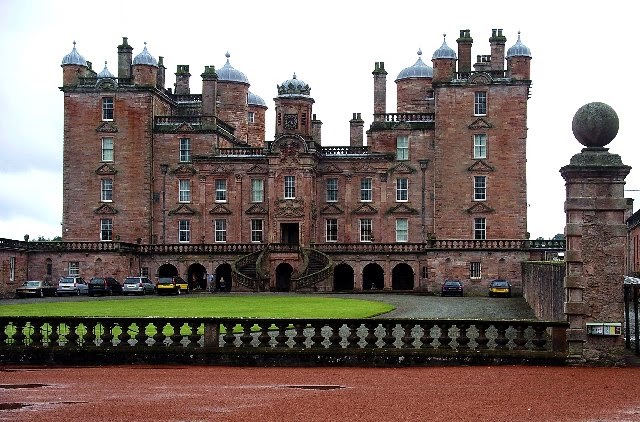
It has to be that way, because we haven't reformed local government finance. We have an absurdly regressive Council Tax system where the bottom of the highest band of values is less than eight times the bottom of the highest, and (in Dumfries and Galloway at present) the tax paid on the highest band is less than four times that paid on the lowest; so Richard Walter John Montagu Douglas Scott pays £3,867.69 on Drumlanrig Castle, while the poorest pensioner in the meanest hovel pays £1,052.43. Scott's wealth is variously estimated between £213 million and £260 million; the median household wealth in Scotland is £239,500, while the median household wealth of the poorest decile is £7,600 [ibid]. Which is to say that a man with about one thousand times the wealth of the median, and thirty thousand times the wealth of the poorest 10%, pays less than four times the tax on that wealth.
If municipalities are empowered to build the strategic layer of local governance from the bottom up, rather than having it imposed from the top down, it will be a better fit for what people actually need.