Extreme Heat
By: Simon Brooke :: 31 July 2026
Edited 13th August to add: This essay is misleading and alarmist. It was written in good faith, but I have since researched and done the maths to more fully explore the probable wet bulb temperatures given the Met Office's scenario, and my assumptions were wrong. This work is documented here.
WARNING: this is an extremely grim essay. I am not an expert on the topics discussed, just an educated lay person trying to understand. I could well be mistaken in my conclusions.
It's a fortnight since I posted my analysis of the Met Office's mid-century temperature projection, and I've been thinking more about it. Apart from immediate human deaths, what are the other consequences of an 'everyone dies' event?
The animal world
Humans have a homeostatic temperature of about 37° C, with a bit of variance; from 36.1 to 37.2 is considered normal, whereas 38 is pathological. So, what animals can survive at higher temperatures than we can? Well, the answer appears to be that most large mammals can, but only slightly. Birds seem to be a bit more tolerant, but, again, not by much.
| Species | Min value ° C | Max value ° C |
|---|---|---|
| Rabbit | 38.6 | 40.1 |
| Sheep | 38.3 | 39.9 |
| Pig | 38.7 | 39.8 |
| Goat | 38.5 | 39.7 |
| Dog | 37.9 | 39.9 |
| Dairy cow | 38 | 39.3 |
| Cat | 38.1 | 39.2 |
| Beef cow | 36.7 | 39.1 |
| Horse | 37.3 | 38.2 |
| Human | 36.1 | 37.2 |
Mammal homeostatic temperatures. Source — admittedly, not a very good source.
Mammals and birds thermoregulate by evaporation, so are vulnerable to 'wet heat' events. What about cold blooded animals, which don't? Can they survive higher temperatures? The answer seems to be that while cold blooded animals are less vulnerable to hot humid weather, they are vulnerable to very hot weather. Bumble bees — and, presumably, some other insect species too — are apparently already dying. Few insects appear to be able to survive exposure to temperatures above 50° C for any significant time.
I don't currently have good information on what temperatures reptiles and amphibians can survive; one would expect many amphibians to see refuge in water during extreme heat, although small ponds might dry up and shallow ones overheat.
Britain is an island. Our amphibians and reptiles reached here before Doggerland sank. It was cool then. It's been reasonably cool (with some variance) ever since. It's reasonable to assume they're cool adapted. I don't know what proportion of amphibians and reptiles would survive in an area affected by an extreme heat event, but it seems unlikely to be many.
Mammals can generally not outrun a heatwave, even if they knew in which direction to run. Our domestic and wild mammals will shelter where they can; and in an event in which many humans die, many mammals will die also. Few mammals will have access to air conditioned buildings or designated shelters; it's doubtful whether even badger setts are sufficiently deeply buried to have adequate protection.
For many domestic animals which need to be fed, the death or evacuation of the staff required to feed them could lead to death by starvation even if they survived the heat. But very widespread deaths of animals across the affected area would be probable.
Birds are slightly more heat tolerant and can move further faster. It's possible that some birds could survive be moving. Equally, even after a very widespread die-off of birds, birds from outside the affected zone could recolonise it fairly quickly after the end of an extreme heat event.
So an extreme heat event which was just beyond the threshold of mass human die off would not necessarily trigger mass domestic animal die off, but it would be a damned close run thing. An 'everyone dies' event which covered a significant area would almost certainly entail an 'everything dies' event covering a slightly smaller area.
The human population
The probable area for such an event, in Britain, is the triangle covering Bristol, Birmingham and London. That's an area inhabited by about twenty million inhabitants. I doubt that there is shelter space for 5% of that population. Of course, the actual affected zone could be larger or smaller than that, but that is the area where hottest temperatures tend to occur.
Evacuation
Some people might successfully evacuate to regions outside the affected zone. People would primarily need to be evacuating north, since even if an extreme heat event was not immediately forecast for the south coast, there would be sufficient uncertainty that it would be unlikely to be possible to guarantee that any part of the south coast would certainly be safe. In the UK, motorway lanes are designed to carry a maximum of between approximately 1100 (rural) and 1900 (urban) vehicles per hour. Road transport evacuation would need to go principally via the M1 and M6. It's likely that southbound lanes would be reassigned as northbound for the emergency, and hard shoulders would be used; but even so it's unlikely that you would have more than twelve northbound lanes over the two motorways.
So at 1900 vehicles per lane per hour, that's 22,800 vehicles per hour, or half a million vehicles per day; over four days, you could maybe get two million vehicles out, which, if we guess an average of eight people per vehicle, could mean that if everything worked perfectly to plan, means you could get about sixteen million people out. Which is way better than I'd guessed, and which, supplemented by rail and air movements, might be enough to evacuate substantially all of the affected population.
But managing a civil defence operation on that scale would take decades of planning (we only have two and a half decades), meticulous organisation and astonishing discipline. If people panicked, the motorways would quickly become blocked. Keeping traffic moving would be an extremely difficult task. It's also doubtful that fuel distribution to filling stations at service areas would be able to keep pace with this level of demand under emergency conditions. Additionally, the roads would be affected by the heat, very likely leading to surface problems in places.
In practice, I would guess that two apparently contradictory factors would both contribute to mass deaths. Many people would be complacent, not heeding warnings until too late; while, also, many people would panic, and try to force their way onto already overcrowded motorways or to go by more minor roads, leaving no clear routes for emergency services. In fact, many of those who were initially complacent would contribute to later panic.
So, while, in principle, I think it would be possible to put in place a civil defence plan to evacuate a substantial portion of England given a week's warning, in practice I think that plan might be very hard to execute.
And, to be clear, those who could not be evacuated, and could not find shelter in old railway tunnels, deep cellars, mine workings or similar places, or air conditioned buildings, would almost certainly die.
Some — possibly many — of those who sheltered in air conditioned buildings would also die, because power grid components are affected by heat and disproportionately fail in hot weather. Maintenance of these components require highly skilled people doing hard physical work in exposed places, which in extreme heat conditions would be suicidal.
Housing and Feeding
Once moved, those sixteen-odd million people would need to be housed and fed.
This would by definition be summer, and warm weather. There might well be thunderstorms, so people would need to have some shelter, but they wouldn't, at least initially, need to have heated spaces. It would be possible to bed a lot of people down in school halls, in industrial or agricultural sheds. Which we would need to do, because this would more or less double the population of northern Britain.
Britain's food distribution system does not have large distributed stocks of pretty much anything. Rather, there is a highly efficient distribution network which delivers food to logistics hubs, and thence to shops, on a 'just in time' basis. Many of the logistics hubs are within the London-Bristol-Birmingham zone; most of the food that is imported is imported through south coast or East Anglian ports. None of these would be usable in such a crisis. Even though the ports might be outside the affected zone, the transport routes are not.
Worse, if Britain is affected to this extent, so, in all probability, will many of the places from which we are used to import food be. Will their harvests succeed? they have surplus food to export? Will their transport infrastructure hold up? All of these things are imponderable.
Finally, even if they wanted to, most of the evacuees would not be able to return home immediately the heatwave was over. There would be huge transport dislocation, limited or no available fuel, probably electricity grid dislocation; probably sewage system breakdowns. Wildfires would almost certainly have broken out, and would have had to be allowed to burn uncontrolled. But, most of all, there would be probably at least hundreds of thousands of human corpses, and literally millions of animal corpses, in the affected zone.
Additionally, the natural processes by which corpses are cleaned up would not be working. We don't in any case have a large enough population of kites, crows, ravens, rats, badgers, foxes and seagulls to clean up millions of corpses. But in addition, most of our population of scavengers would have died, too. Hopefully bacterial decomposition would still work, but that's a slow, stinky, toxic process.
Rather than a fortnight of displacement, for most evacuees there would be a period of months before the areas from which they'd fled were safe to return to.
So without very substantial preparation including absolutely massive distributed regional stocks of food, evacuation by itself would save few lives.
And, in the end, what would there be to return to?
A land bereft of livestock. A land strewn with the carcasses of the unburied dead, both human and animal. A land in which few birds would sing, few trees still have leaves, few flowers bloom. A land in which all the systems of everyday life are vastly disrupted, barely function. And a land which would forever be under threat of the same thing happening again.
The Met Office's projection was for 2056 — just thirty years time. Everyone now in school would be only in middle age. Most people still in work would be elderly, but still alive. This is not the distant future.
Of course, the Met Office were projecting a dry heat event, which would not be deadly; but analysis of the 2026 heatwaves so far suggests that a heatwave in Britain is still, as of 2026, more likely to be humid, and while this could change I haven't seen evidence that it will.
So if we are to have a heatwave in mid century, as the Met Office suggest, then it is highly plausible that it will be humid. If we have a dozen heatwaves in the period 2050 to 2060, it is virtually certain at least one will be humid.
But 2056 is in any case not the peak of the projected warming curve. We're currently almost at 1.5° C warming, at emissions are still trending upwards. We cannot now achieve a peak warming below 3° C, and consequently, the peak of the curve will be after 2100.
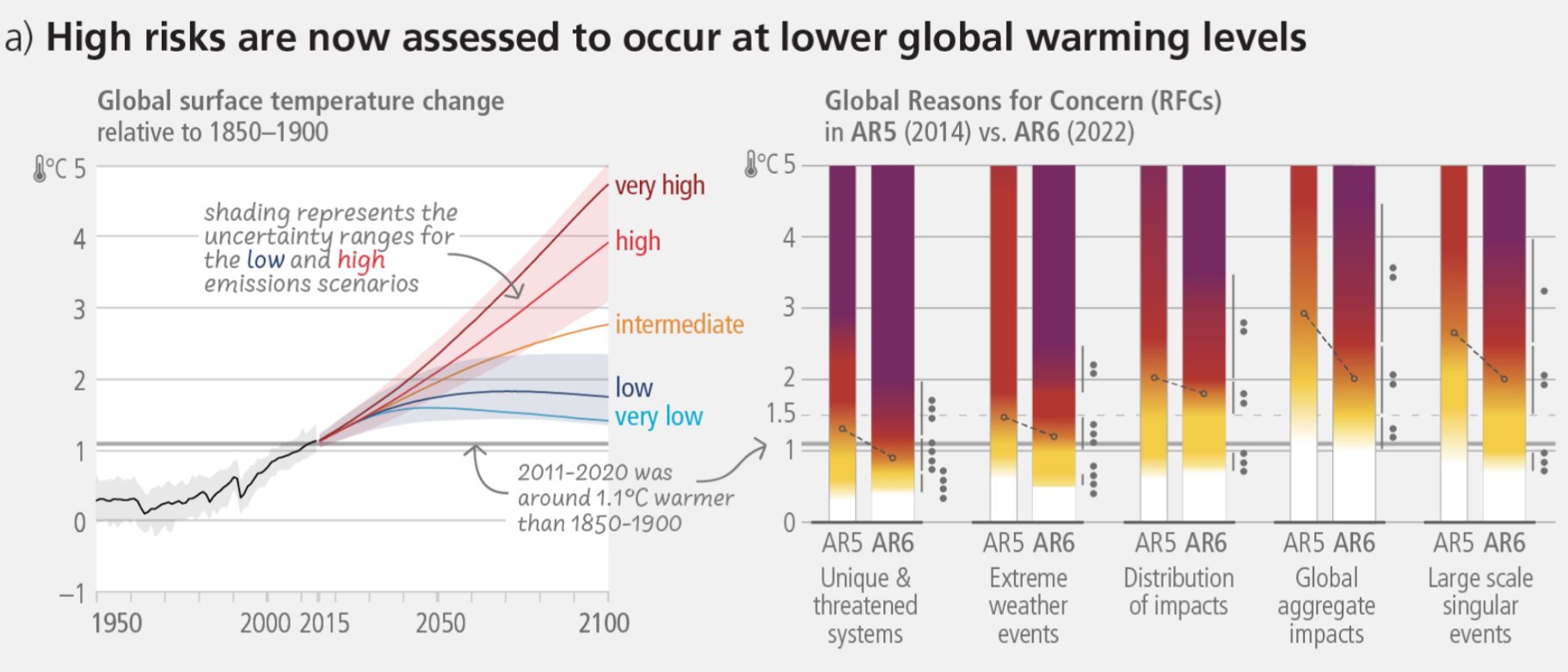
[Source]
So even if Britain can survive the 2050s, the danger is by no means over; our summer maxima could still continue to rise.